
 Authored by:
Rianka Gupte
Authored by:
Rianka Gupte
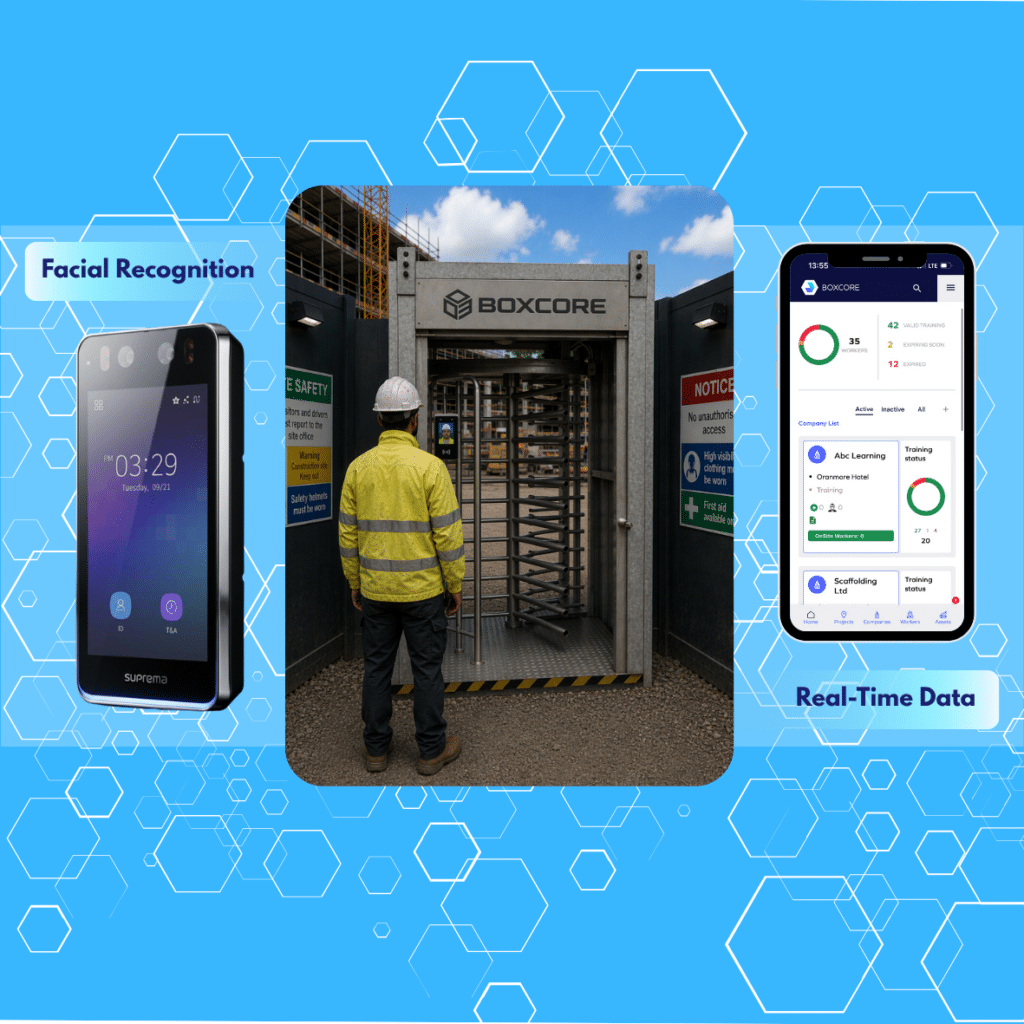
Construction site access control in New York should do far more than open a gate or record a clock-in. For General Contractors, the real questions are: who is actually on the jobsite, which subcontractor do they work for, are their OSHA and SST cards current, and can you prove all of it later if there is a claim, dispute or audit?
Boxcore brings construction access control, facial recognition, workforce attendance and safety compliance into one system, so the worker entering the project is connected directly to their safety and compliance record.
Know who is on site. Know they are compliant. And have the records to prove it.
Most New York projects don’t lack workforce data. They have subcontractor timesheets, Superintendent reports, payroll records, Orientation records, SST and OSHA cards and access logs. The problem is that this information is disconnected.
A worker is listed on a timesheet for ten hours on Tuesday. A swipe card shows a card entered the site, but was it the right person? A sign-in sheet has a name, but who wrote it? An SST card was checked at onboarding, but is it still valid?
That gap between what has been reported and what can actually be verified is where buddy punching, ghost workers, credential misuse, inflated crew counts and questionable claims take hold. Boxcore was built to close it.
Skycore Builders operates across the New York, New Jersey and Connecticut Tri-State area. Michael Amore, Director of Risk Management, has described the fraud problem facing the sector as a multi-year construction “Fraudemic”.
Speaking about Skycore’s experience using Boxcore, Amore said:
“Using Boxcore was a huge asset in helping us fight back against this industry-wide problem.”
The impact has gone beyond catching discrepancies. According to Amore, the system itself has become a deterrent:
“The problems we faced during this ‘Fraudemic’ are basically now non-existent. Just the sight of their systems at our projects has been a deterrent against bad actors in the industry.”
Traditional credentials have one basic weakness: they can be separated from the person they are meant to identify. A swipe card can be handed over, a PIN can be shared and a paper register can be filled in for someone who isn’t there.
A ghost worker appears on a timesheet, payroll record or subcontractor invoice without having done the work. Buddy punching is a variation of the same problem, where one person clocks in for another who is late, absent or already gone.
Facial recognition links every attendance event to the registered worker, who must be physically present. There is no card to pass on and no PIN to share. The result is an independent, timestamped workforce record that can be checked against subcontractor timesheets, labor invoices and payroll.
Imagine receiving a claim that an individual was injured on your project on a particular date. The first question can be surprisingly hard to answer: was that person actually on the project?
With paper sign-in sheets and fragmented records, answering it means digging through Superintendent reports, emails, payroll and subcontractor timesheets, and the answer may still be unclear.
A verified facial recognition attendance record shows whether the individual was registered, whether they entered the site, when they arrived and when they left. If there is no verified attendance record, that also forms part of the investigation. An access record alone doesn’t decide whether a claim is valid, but it gives the contractor far stronger evidence when establishing the facts.
Knowing who is on site is only half the problem. You also need to know whether they should be there. On many covered New York City jobsites, Local Law 196 requires workers to hold appropriate Site Safety Training, with different requirements depending on role. Full details are on the NYC Department of Buildings’ Site Safety Training page.
Boxcore records project Orientation, OSHA cards, SST cards, project-specific and task-specific training against each worker’s profile. That changes the question at the gate from:
“Do we recognise this person?”
to:
“Is this the correct person, and are they currently approved to enter this project?”
Where Boxcore controls physical access, approval is linked to the project’s requirements. If mandatory training is missing or expired, access can be restricted based on the configured project rules. Nobody at the gate needs to remember that a worker’s card expired yesterday. The system does the checking.
When a turnstile comes from one supplier, facial recognition from another and safety records from a third, a worker who can’t get in leaves the Superintendent guessing which supplier owns the problem. Boxcore combines safety, workforce management and access control, so there is one system and one point of contact when something needs fixing.
It also works with or without a turnstile. A Manhattan high-rise may need turnstiles and tightly controlled entry, while a smaller fit-out may only need accurate facial recognition time and attendance. Either way, the worker and compliance record stays consistent across your portfolio.
Implementation includes migrating existing training data, initial training and direct support for subcontractors, with teams typically operational in hours or days rather than weeks. Ease of use matters: if a system is difficult, people find ways around it, and the data stops being reliable.
Verified workforce data isn’t only for fraud and claims. Superintendents can see how many people are on site, which subcontractors are present, when crews arrived and left, and whether anyone unapproved has turned up, without ringing foremen or walking the site for a headcount.
As Michael Amore puts it:
“Boxcore has allowed us to help better control our jobsite personnel by knowing at all times who is on site, the times they are on site, and ensuring they have the proper credentials to be on site.”
From worker onboarding, training records, compliance tracking, safety documents, equipment management, to on-site time and attendance tracking — Boxcore’s software greatly simplifies construction site safety.
It ties each attendance event to the registered worker, who must be physically present. That makes buddy punching, card sharing and ghost workers far harder, and creates an independent record to check against timesheets and invoices.
Yes. SST and OSHA card information is recorded in each worker’s compliance profile alongside project Orientation and project-specific and task-specific training.
Where Boxcore is connected to controlled access and project rules are configured, workers missing required training can be restricted from entry.
No. It can run with turnstiles where controlled entry is required, or as a standalone facial recognition time and attendance system.
If you want to reduce your exposure to workforce fraud, strengthen safety compliance and build a defensible record of who is on your jobsites, book a demo with the Boxcore team.