
 Authored by:
Padraig Reilly
Authored by:
Padraig Reilly
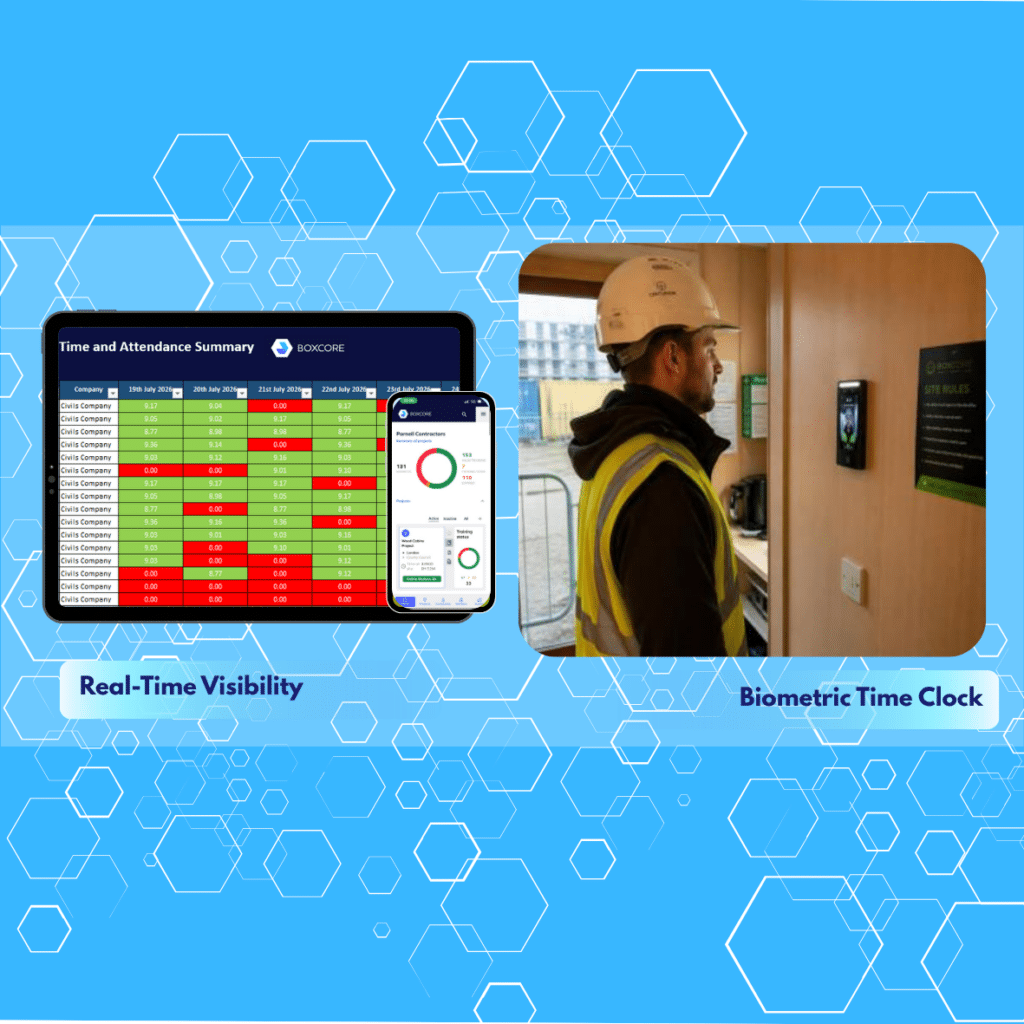
Facial recognition time and attendance for construction helps general contractors verify who is actually on a jobsite, when they arrived, when they left and whether they are approved to work.
In most Construction Projects Contractors don’t have a reliable way to know who is on site and whether to on site have the required training and approval to be on site.
Contractors may still depend on paper sign-in sheets, swipe cards, PIN codes, handwritten Superintendent reports and subcontractor timesheets. These methods record what someone claims or which credential was used. They don’t prove that the correct person was physically present and are easily abused by bad actors which has led to an epidemic of false and fraudulent claims on projects.
This gap creates opportunities for buddy punching, ghost workers, inflated crew counts, inaccurate labor classifications, shared credentials and unauthorized access.
Modern cloud-based facial recognition systems such as Boxcore close that gap by connecting a verified identity with attendance, project orientation, OSHA and SST cards, project-specific training, task-specific training and subcontractor approval.
For general contractors, this creates an independent, real-time workforce record. It can greatly reduce fraud exposure, improve jobsite safety and provide clearer evidence when reviewing timesheets, certified payroll and subcontractor pay applications.
Construction payroll fraud is the intentional falsification or manipulation of workforce records for financial gain.
It can occur within a contractor’s direct workforce or through subcontractor billing. Common examples include:
Not every incorrect record is fraud. Delayed timesheets, administrative mistakes and poor communication can also result in inaccurate labor data.
The underlying control weakness is often the same: the general contractor does not have an independent record showing which workers were physically present.
The Association of Certified Fraud Examiners’ 2026 research analyzed 2,402 occupational fraud cases that caused more than $3.4 billion in reported losses. It also found that fraud detected within six months caused a median loss of $40,000, while schemes continuing for more than five years produced median losses exceeding $1.1 million. These figures cover occupational fraud generally rather than construction attendance fraud alone, but they show why early detection matters. (ACFE)
Construction projects are unusually difficult environments in which to maintain accurate worker and payroll records.
A large project may involve a general contractor, dozens of subcontractors, lower-tier subcontractors, labor providers, specialist trades and workers moving between different projects.
Crews change regularly. Workers may arrive before management staff, work different shifts, leave through different access points or transfer between controlled work areas.
The construction Superintendent is also dealing with production, safety, inspections, deliveries, subcontractor coordination and daily reporting. Manually checking every worker against separate spreadsheets, folders and emails is not realistic.
This is why fragmented and manual workforce processes create so much risk.
A contractor may have:
Each individual process may appear acceptable. The problem is that none provides a complete answer to the most basic workforce questions:
Who is on site?
When were they there?
Which company do they work for?
Are they trained, properly documented and approved to be there?
A connected construction workforce management platform brings these records together so that the person entering the jobsite is connected to the same profile used for attendance, credentials, orientation and approval.
A ghost worker is a person who appears on a payroll record, timesheet or subcontractor invoice but did not perform the work being billed.
The individual may not exist at all. In other cases, the worker is real but was not present during the claimed hours.
Ghost worker fraud can be difficult to identify when a general contractor relies on weekly attendance records supplied by each subcontractor. The documentation may look complete, but the contractor has no independent way to confirm it.
Facial recognition time and attendance changes this by requiring the worker to be physically present to create an attendance event.
A verified workforce record can show:
This does not prove that every billed hour or labor classification is correct. Contractors still need effective payroll, contract administration and pay application controls.
It does provide objective evidence against which subcontractor claims can be checked.
Where a person has no verified jobsite attendance, the project team can question any labor hours billed for that worker before payment is approved.
Buddy punching occurs when one worker records attendance for another person.
The absent worker may be late, leave early or not attend at all. A colleague clocks them in using a swipe card, PIN code or paper sign-in sheet.
Cards and PINs do not solve this problem because they can be shared.
Facial recognition requires the registered worker to be physically present. The system checks the person at the attendance or access point against the approved worker profile.
There is no card to hand to someone else and no PIN to share.
This produces a more reliable record of:
It also creates a fairer process for subcontractors. Every company is measured against the same verified attendance record rather than informal observations or inconsistent manual checks.
Skycore Builders is a leading contractor working across the Tri-State region of New York, New Jersey and Connecticut.
The company operates on demanding projects where accurate attendance, worker credentials, subcontractor controls and real-time workforce visibility are essential.
Michael Amore, Director of Risk Management at Skycore Builders, describes the wider payroll and workforce fraud problem as a multi-year construction “Fraudemic”.
For Skycore Builders, this went beyond inaccurate timekeeping. It created a broader risk involving worker identity, credentials, site access and subcontractor accountability.
Amore said:
“The construction industry was going through a multi-year timeframe which some labeled as the ‘Fraudemic’. Using Boxcore was a huge asset in helping us fight back against this industry-wide problem.”
Boxcore has helped Skycore Builders see who is on site, the times each person is present and whether workers have the credentials required to attend.
“Boxcore has allowed us to help better control our jobsite personnel by knowing at all times who is on site, the times they are on site, and ensuring they have the proper credentials to be on site.”
The system has not only helped identify discrepancies. According to Amore, its presence has discouraged attempts at fraud.
“The problems we faced during this ‘Fraudemic’ are basically now non-existent. Just the sight of their systems at our projects has been a deterrent against bad actors in the industry.”
Amore added:
“I would recommend Boxcore to any company looking to better their policies and jobsite safety.”
Brian McKillon, Senior Superintendent at Skycore Builders, sees the benefit from the day-to-day project management side:
“With Boxcore, I have full control of who is on site at any given time, instant visibility of our workforce and complete confidence that only approved workers with the required training in place can attend the project. This has dramatically reduced our exposure to fraud risk.”
These comments show why facial recognition is more than a payroll clock.
The risk team gains a clearer audit trail. The Superintendent gains immediate workforce visibility. The safety team can confirm that orientation and training requirements are in place. The commercial team has better data against which to review subcontractor claims.
The same connected process addresses several risks because payroll fraud, credential fraud and unauthorized access often begin with the same weakness: no reliable connection between identity, attendance and approval.
Inflated crew counts occur when a subcontractor invoices for more workers than were actually on site.
A small daily difference can become a significant cost when repeated across several crews, weeks or billing periods.
Without reliable attendance data, contractors may need to reconstruct crew numbers from:
This is slow, and it can still leave room for dispute.
Facial recognition creates a timestamped entry and exit record for each worker. Project teams can then review attendance by worker, company, date or project without combining several manual sources.
For general contractors managing multiple subcontractors, this information can support:
The system does not replace commercial judgment. It gives the project and commercial teams better information on which to base that judgment.
Rate fraud occurs when a subcontractor bills for a higher-paid labor classification than the worker actually supplied.
An apprentice may be billed at a journeyman rate. General labor may be billed as a specialist trade. Workers may also be assigned to the wrong classification on certified payroll.
For construction covered by the Davis-Bacon and Related Acts, contractors and subcontractors must pay applicable prevailing wages and fringe benefits. Covered contractors must also submit weekly certified payroll records. (DOL)
Facial recognition cannot determine the correct wage classification by itself.
It can strengthen the record by connecting a verified individual to:
The contractor can then compare the worker who physically attended with the classification listed in the pay application or certified payroll report.
Formal wage, payroll and classification review processes are still required. Verified attendance provides supporting evidence.
Facial recognition works best when it is connected to a complete worker compliance record.
A basic biometric clock confirms identity and time. A construction-specific system should also determine whether the worker is approved to attend.
With Boxcore, project requirements can include:
This lets the project team answer a series of checks before access is granted:
Where Boxcore is connected to controlled access, workers who do not meet the defined project requirements can be prevented from entering.
That is a stronger control than checking a name against a spreadsheet at the start of the project and assuming the information remains correct.
From worker onboarding, training records, compliance tracking, safety documents, equipment management, to on-site time and attendance tracking — Boxcore’s software greatly simplifies construction site safety.
OSHA and SST cards are frequently collected through emails, shared folders and spreadsheets.
This makes missing records and expiry dates difficult to manage, particularly where hundreds of workers and numerous subcontractors are involved.
Boxcore gives contractors one place to record and track:
For covered New York City construction jobsites, workers must be able to provide an SST card showing at least 40 hours of required training. Site Safety Managers, Site Safety Coordinators, Construction Superintendents and other designated supervisory personnel require a Supervisor SST card showing at least 62 hours. (New York City Government)
NYC requirements changed on May 3, 2026, including changes to accepted course pathways. Contractors should follow current NYC Department of Buildings guidance and use the required Training Connect process to validate relevant cards. (New York City Government)
Boxcore does not replace official card issuance or validation. It helps contractors manage the validated credential within the wider worker approval and access process.
The key benefit is that training is connected to daily attendance.
The Superintendent does not simply know that a document was uploaded months ago. The team can see whether the person entering the jobsite today has the required training in place.
An OSHA or SST card does not confirm that a worker has completed every requirement for a particular project or task.
Each general contractor may have additional requirements based on the scope, client, hazards and work environment.
These may include:
A worker may be generally approved for the project but not approved for a particular activity.
Boxcore allows contractors to track both project-level and task-level requirements rather than treating compliance as a single yes-or-no field.
This reduces the risk of a worker entering the project with a valid general card but without the training required for the work they are expected to perform.
Orientations are normally treated as a safety and onboarding requirement. They also provide an important identity and workforce control.
A properly managed orientation confirms that the worker has been registered, connected to the correct subcontractor and briefed on the project’s rules.
When orientation and attendance are separate, a worker can arrive without the Superintendent knowing whether the correct process was completed.
One person may also complete a remote orientation for someone else if identity is not verified.
Boxcore helps contractors:
This creates continuity from onboarding to daily entry.
The individual who completed the orientation is the same individual whose identity is checked when arriving at the project.
Boxcore’s construction worker onboarding platform connects worker records, orientations, training and approval rather than leaving them across disconnected systems.
Worker credentials are only one part of contractor risk.
General contractors also need to confirm that subcontractors have the required insurance and project documentation in place before their workers mobilize.
Insurance information is frequently managed through emails, spreadsheets and shared folders. This makes it difficult for Superintendents to know whether a company remains approved.
Boxcore can help teams track:
Connecting subcontractor approval with worker access creates a stronger control.
A worker may hold the correct training cards, but the company sending them to site could have expired insurance or incomplete contractual documentation.
A connected system checks both levels:
Is the worker approved?
Is the subcontractor approved?
This reduces the risk of crews mobilizing before the required company documentation is in place.
Swipe cards are familiar, but they have a fundamental weakness: the credential can be separated from the person.
Cards can be:
PINs have the same problem. They prove that someone knew the number, not that the correct worker attended.
Facial recognition connects the attendance event directly to the person.
This makes it harder to clock in on behalf of another worker, use a borrowed credential or create attendance for a ghost employee.
The effectiveness of the system still depends on the quality of its hardware, software and implementation.
Contractors should not assess facial recognition as a standalone device. They should consider whether it works reliably on construction sites, connects with worker records and is simple enough for site teams to use every day.
Older access control systems were often difficult to configure and heavily dependent on local hardware, servers and manual programming.
Modern cloud-based facial recognition solutions such as Boxcore are easier to use, faster to set up and simpler to manage across multiple construction projects.
Authorized teams can manage workers, attendance and approval through a secure online platform rather than maintaining a separate local database for each site.
A practical cloud-based system should allow contractors to:
Boxcore can be used as a standalone time and attendance solution or connected to turnstiles and other controlled access points, depending on the project’s needs. Its platform provides real-time workforce visibility and links access to worker approval status.
Accuracy and technical capability matter, but they do not guarantee success on a live project.
The real test is whether Superintendents, safety teams, subcontractors and workers use the system consistently.
Construction projects have little tolerance for software that creates queues, requires constant technical support or takes months to implement.
Morning entry must remain fast. New workers need to be added without delaying the crew. Superintendents need answers without searching through several menus.
A facial recognition system should reduce work for site teams rather than adding another administration task.
Ease of use also affects data quality.
When software is difficult to use, teams find workarounds. They create parallel spreadsheets, delay updating credentials or allow workers through without completing the proper checks.
When the process is straightforward, teams are more likely to:
Boxcore was designed specifically around rapid adoption by frontline construction teams. The platform combines worker onboarding, training, documents, time and attendance and access control through a straightforward interface. Its implementation includes initial training, existing data migration and support for subcontractors.
This focus on field adoption is central to Boxcore’s product approach. The company has consistently designed its software around practical site workflows rather than office-only reporting.
Project mobilization can involve hundreds of workers arriving across a short period.
A lengthy software rollout can delay access, create long lines and force the project team back onto manual systems.
Modern construction facial recognition software should be able to become operational in hours or days, not weeks or months.
Fast implementation normally depends on:
Boxcore’s onboarding model is designed around the reality that construction teams are time-poor. Existing worker and training information can be transferred into the platform, while site teams and subcontractors can be trained without a lengthy implementation program.
This allows contractors to introduce stronger controls without disrupting project delivery.
Construction access points are not controlled office environments.
Facial recognition equipment may need to operate through:
A device that works during a product demonstration but fails during morning entry will quickly lose the confidence of the project team.
Workers will be delayed, Superintendents will create exceptions and the attendance record will become less reliable.
Construction contractors should therefore select systems designed and tested for demanding access environments.
Modern facial recognition technology has improved significantly, but performance differs between algorithms and operating conditions. NIST maintains ongoing evaluations of facial recognition systems, including one-to-one verification, video identification and performance where faces are partially obscured. (NIST)
Boxcore combines cloud-based construction workforce software with facial recognition hardware selected for reliable field performance. The platform allows teams to update worker status centrally rather than manually reconfiguring individual access devices.
When a required document expires or a worker remains unapproved, the central record can be updated so that the latest status is reflected in the access process.
Facial recognition involves sensitive worker and biometric information.
Contractors should not introduce biometric attendance without examining how that data is collected, processed, protected, retained and deleted.
A construction workforce platform may hold:
This information should not be managed through insecure local files, open spreadsheets or systems with limited permission controls.
Leading platforms should provide advanced security and privacy controls as standard, including:
Boxcore is independently SOC 2 Type II certified and has built data security and privacy into the platform’s core controls.
Independent assurance is important because contractors should not have to rely solely on a software provider’s own security claims.
Role-based access is also essential.
A Superintendent may need to see current attendance and approval status. A safety team may require access to training. A commercial manager may need company-level labor reports. A subcontractor should only be able to maintain records for its own workforce.
Each person should see the information required for their role rather than receiving unrestricted access to all worker data.
A basic attendance clock tells the contractor that a person arrived and left.
A construction workforce platform should connect that event to the person’s wider compliance status.
Boxcore connects facial recognition with:
Before mobilization, the contractor can collect worker and subcontractor records, issue orientations and review credentials.
When the worker arrives, facial recognition verifies their identity.
While the project is live, the Superintendent can see who is present and review attendance by worker, subcontractor, project or date.
This creates a stronger process than using one system for access, another for training and separate spreadsheets for workforce records.
Contractors assessing biometric time and attendance should consider the complete system rather than choosing hardware based on a specification sheet.
The system must confirm that the person recording attendance matches the approved worker profile.
Superintendents should be able to see who is currently on site without waiting for a manual report.
Teams should be able to review arrival and departure records by worker, company, project and date.
Attendance should connect to OSHA, SST, trade, project-specific and task-specific training.
The system should show whether the correct project orientation was issued, completed and approved.
Worker approval should connect to the company employing the person, including required insurance and project documentation.
Hardware must work under real construction conditions and process workers quickly during peak entry periods.
The platform should be deployed without a long software implementation or complex local server infrastructure.
Superintendents, safety teams and subcontractors should be able to use the system with minimal training.
The provider should have clear, independently assessed controls for protecting worker and biometric information.
Contractors should be able to manage several projects, devices and workforce records through one platform.
It is a workforce tracking system that uses facial recognition to verify the identity of a worker when they arrive at or leave a construction project.
A construction-specific platform can also connect the worker’s attendance to orientation, training, credentials and access approval.
It can significantly reduce buddy punching because the registered worker must be physically present.
A colleague cannot simply borrow a card or use a shared PIN.
A worker must have an approved profile and create a verified attendance event.
If a person never attends the project, there should be no independent attendance record to support billed hours.
No system can eliminate every form of fraud.
Facial recognition removes several common weaknesses and gives contractors better evidence for identifying questionable payroll, attendance and subcontractor billing.
Boxcore can record and manage OSHA, SST and other training information as part of each worker’s profile.
Official cards should still be issued and validated through the relevant authority and required process.
Yes. Project orientations can be issued, tracked and recorded against the worker’s approval status.
Where the project’s access control setup supports it, approval rules can be used to prevent access when mandatory records are missing or expired.
Boxcore can store and track required subcontractor documentation, including insurance records, approval status and expiry dates.
The reliability of any system depends on its hardware, configuration, operating conditions and implementation.
Modern systems designed for construction can provide fast and consistent performance in demanding environments when properly installed and managed.
Rules vary by state and city.
Contractors should review applicable biometric privacy, employment, labor and contractual requirements and obtain legal advice before deployment.
Ghost workers, buddy punching, inflated crew counts and credential misuse all depend on a gap between what is reported and what can be independently verified.
Paper timesheets record claims.
Swipe cards record the use of a credential.
Facial recognition records the physical presence of the approved person.
When that verified identity is connected to orientation, OSHA cards, SST cards, project-specific training, task-specific training, subcontractor insurance and access approval, general contractors gain a much clearer view of their workforce.
Skycore Builders’ experience shows the practical result.
Michael Amore, Director of Risk Management, reports that Boxcore helped the contractor fight back against the construction “Fraudemic” and that the visible presence of the system has acted as a deterrent.
Brian McKillon, Senior Superintendent, has full visibility of who is on site and confidence that only approved workers with the required training can attend the project.
The value comes from more than facial recognition hardware.
It comes from combining accurate identity verification with reliable field performance, rapid implementation, easy site adoption, strong security and one connected source of workforce information.
For general contractors carrying significant labor costs and subcontractor exposure, that provides dependable answers to three questions:
Who is on the jobsite?
When were they there?
Were they approved, trained and properly documented to attend?
Reliable answers help protect project margin, improve jobsite safety and dramatically reduce exposure to workforce and payroll fraud.
Learn more about Boxcore’s construction access control and facial recognition software.
From worker onboarding, training records, compliance tracking, safety documents, equipment management, to on-site time and attendance tracking — Boxcore’s software greatly simplifies construction site safety.