
 Authored by:
Padraig Reilly
Authored by:
Padraig Reilly
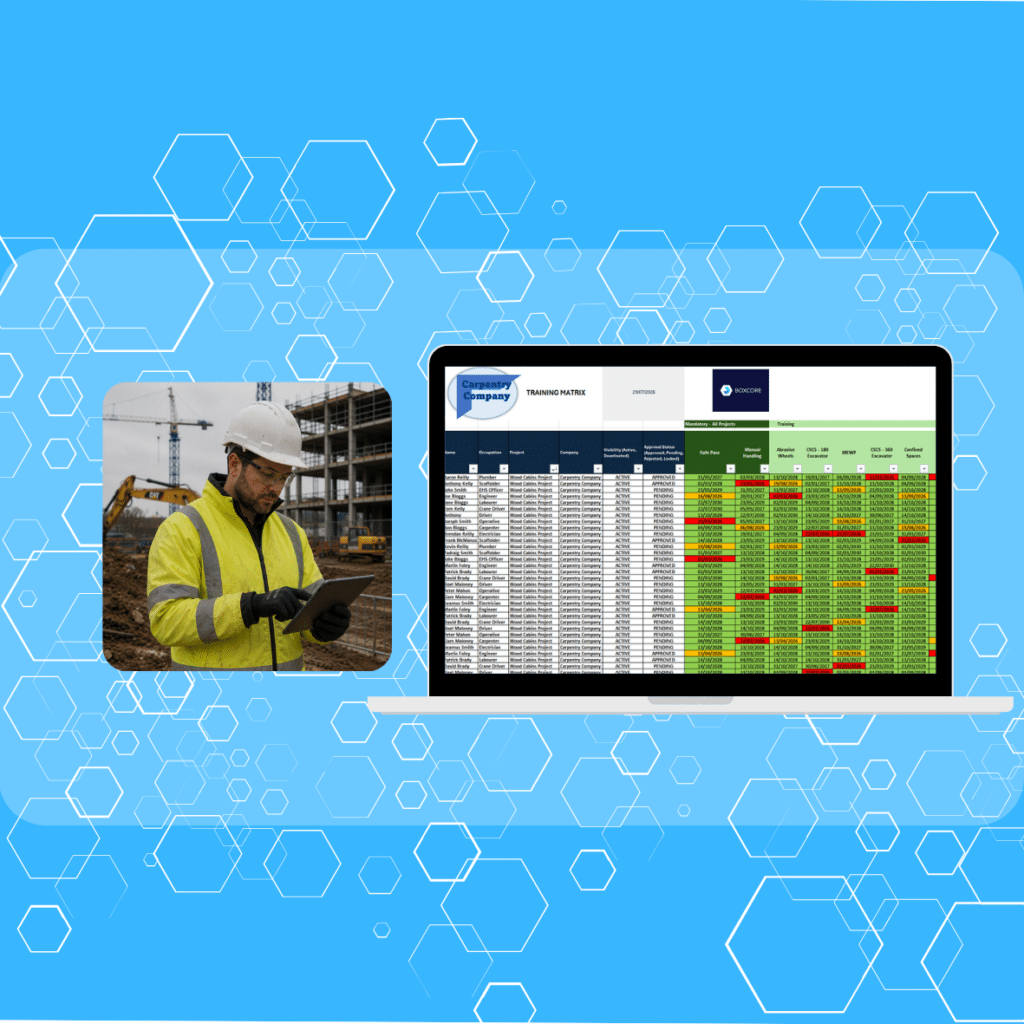
Access control in construction is no longer just about keeping the wrong people out. It is now part of how you run the job: proving who is on site, confirming competence before work starts, reducing disputes over hours, and giving project teams real visibility across contractors and subcontractors.
For busy contractors, the challenge is that sites are dynamic. Crews change daily. Multiple subcontractors arrive at different times. A gatehouse might be unmanned for periods. And when a client or auditor asks, “Who was on site on Tuesday at 07:10 and were they competent for the task?”, you need an answer in seconds, not a scramble through sign-in sheets.
This article breaks down the three main types of access control system used in construction today: card systems, fingerprint systems, and facial recognition. It then explains why facial recognition is usually the strongest choice on live construction sites, and what else you should demand from an access control setup beyond the biometric method itself.
Boxcore is built to make this practical on real projects across Ireland, the UK, and the USA, with access control tied directly into onboarding, training records, and live attendance visibility.
On most projects, access control now carries responsibilities that used to sit across different tools and processes:
If your access control is not connected to onboarding and training records, it often becomes a “gate-only” tool. It might stop a stranger walking in, but it will not stop a worker whose cert has expired from starting a task.
That is the gap Boxcore focuses on: linking secure access with workforce onboarding and safety compliance, in a way that site teams can actually run day-to-day providing secure, reliable and fast way to manage access control in construction sites.
How it works:
A worker presents a card or fob at a reader, or taps in at a turnstile. The system checks whether the card is valid and logs an entry.
Why cards are popular on construction projects:
Where card systems cause problems on site:
Construction reality:
Cards can work well for controlled environments, but on busy projects they often become a weak link because the identity check is not truly tied to the person.
In the UK, many contractors already deal with CSCS card checks as part of competence management. If your access control is separate from that process, you are effectively running two systems. Boxcore is designed to bring workforce records and access control into one workflow, so the site team is not duplicating effort.
How it works:
A worker places a finger on a scanner. The system matches the print template to a stored profile and logs the entry.
Why fingerprint systems look attractive on paper:
Why fingerprint is often a poor fit for construction sites:
On live projects, the practical issue is not whether fingerprint is “secure in theory”. It is whether it stays reliable at 07:00 on a wet Monday when everyone is trying to get through the gate.
How it works:
A camera captures an image of the worker’s face and matches it to a stored template. Entry is logged automatically when the match is confirmed.
Why facial recognition is increasingly the best access control method for construction:
Boxcore’s approach to facial recognition is designed to be simple for site teams. Workers are enrolled quickly by taking two photos in the app, and the system can support secure access control and attendance tracking in one place.
Boxcore also references the use of reliable on-site hardware options (where required), including devices selected for construction conditions.
When contractors compare access control systems, they often focus on the method (card, fingerprint, face). In practice, the method matters because it affects site adoption and data accuracy.
Facial recognition tends to win on construction projects for five practical reasons:
Construction is hard on physical tokens (cards) and hard on hands (fingerprints). Facial recognition avoids both problems in one move.
If a system causes delays or fails frequently, people find ways around it. Facial recognition generally improves reliability and speed, which reduces the temptation to bypass the process.
If the client asks for headcount history by contractor, the quality of your report depends on the accuracy of identification. Facial recognition produces cleaner, more defensible attendance data because it is tied to the individual. Boxcore Solution Overview
Where teams move between projects, facial recognition is simpler to roll out consistently. It is not dependent on a local stack of cards, printers, and replacements.
The best access control is connected to onboarding and training records. Facial recognition enrolment can be built into onboarding so the worker is “site ready” before they arrive at the gate. Boxcore is built around this principle: onboarding is fast, records are centralised, and access control can be enforced against approved status.
Choosing facial recognition is a strong start, but it is not enough on its own. If you want access control in construction to reduce admin and support compliance, make sure the system also delivers these five essentials.
Construction teams do not want another box in the site office that needs maintenance, updates, and troubleshooting. A cloud-based platform means:
Boxcore is designed as a cloud-first platform that gives teams visibility on safety and workforce data from any device, helping remove data silos and reduce manual admin.
Access control should not be a standalone gate tool. It should enforce your “approved to work” status.
That means the platform must connect:
Practical examples by region:
If access control in construction solutions are connected to those records, the gate process becomes a compliance control point, not a paperwork checkpoint later.
Boxcore is built to automate training registers and keep training, onboarding, and workforce access aligned in one platform.
Helpful reads:
Access control in construction needs to not require any effort to administer. Busy site managers, foremen and superintendents don’t have time for having to manually input data of log onto clunky software to check information. If the interface is slow or confusing, it becomes the reason the gate is “down” again.
Boxcore’s has been designed with this principle first and foremost: it is built around frontline adoption, so foremen, superintendents (USA), and site teams can check status quickly and keep work moving.
As Padraig Reilly, Founder of Boxcore, puts it:
“Software that looks good in a demo is pointless if it does not work on a live site. Our focus has always been on making sure training and safety data is actually used by site teams, not just stored for audits.”
Access control data is only useful if it is visible without effort.
On a live project, teams need to see:
Boxcore highlights real-time visibility as a core benefit, including near-instant insight into labour levels and who is on site.
Related pages:
Most access control headaches come from subcontractor churn: new starters, changed gangs, and constant data requests.
Boxcore is used heavily by subcontractors as well as main contractors, which matters because subcontractors typically own the workforce data and need to share it with clients efficiently.
When your access control in construction solution is tied to a workflow that subcontractors will actually use, compliance improves without forcing constant chasing from the main contractor.
Boxcore’s model is straightforward: bring safety data and workforce management into one platform so the site team can run the job without juggling spreadsheets, emails, and separate registers. Boxcore Solution Overview
For access control in construction specifically, Boxcore combines:
It can also operate as a standalone workflow or connect into physical site entry infrastructure depending on project requirements.
This matters across regions because while terminology and cards differ (Safepass, CSCS, SST, OSHA), the operational problem is the same: you need a simple system that site teams will actually run daily, and that keeps compliance and workforce visibility connected.
If you are evaluating access control in construction options, use this checklist to pressure-test any solution:
If the answer to any of these is “not really”, the risk is that the system becomes another admin task instead of a site control tool.
If you want access control in construction that does more than open a gate, Boxcore is designed to connect site access with onboarding, training compliance, and real-time attendance visibility, in a way that works for site teams and subcontractors.
Explore how Boxcore supports site access control and workforce tracking by booking a demo and see why over 200 contractors are choosing Boxcore to simplify safety and access control on sites.
From worker onboarding, training records, compliance tracking, safety documents, equipment management, to on-site time and attendance tracking — Boxcore’s software greatly simplifies construction site safety.