
 Authored by:
Padraig Reilly
Authored by:
Padraig Reilly
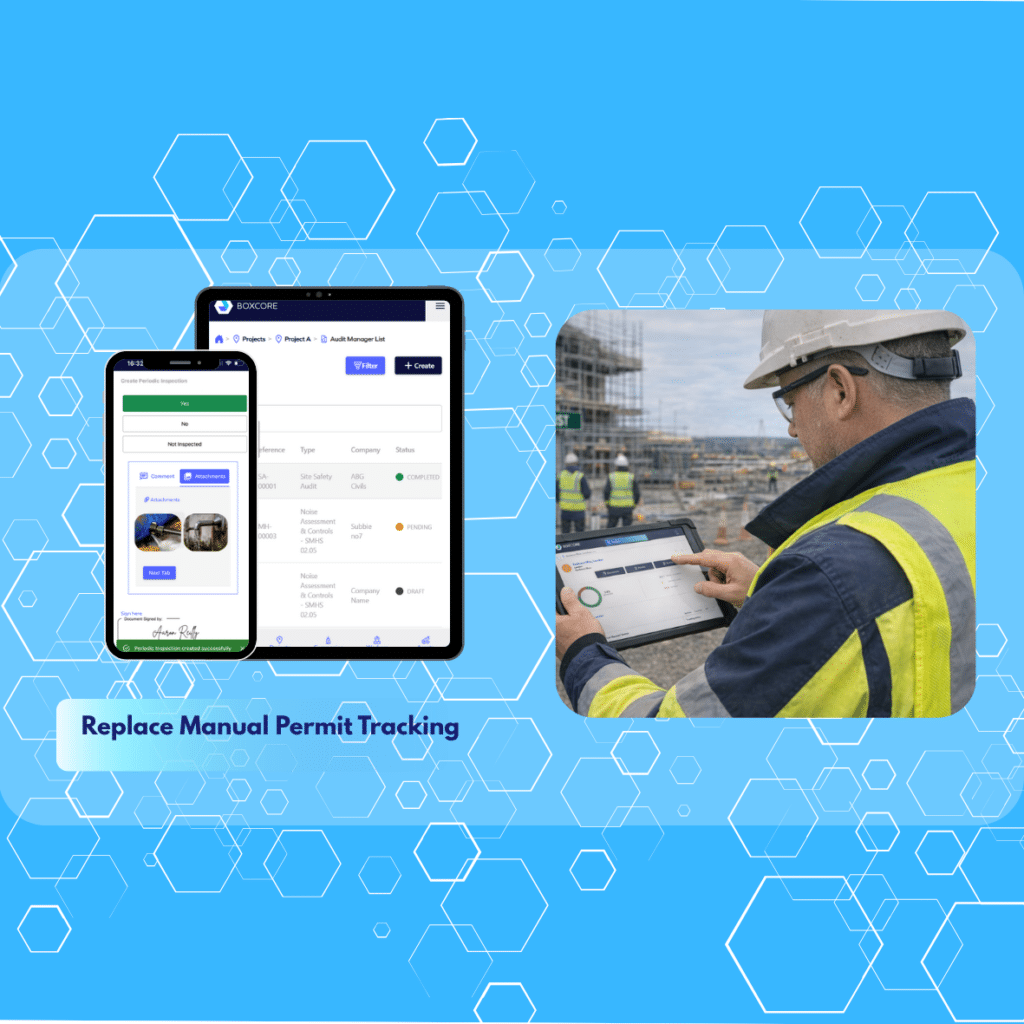
Health and safety software is now a commercial advantage for UK contractors, not just a compliance requirement. With tighter HSE expectations, rising insurance pressures, and the Construction (Design and Management) Regulations, The Golden thread requirements driving accountability, the way contractors manage safety data directly affects their bottom line.
Across the UK, Boxcore’s health and safety software is helping contractors deliver projects faster and with fewer administrative bottlenecks – from major data centres and civil infrastructure works to commercial builds and residential developments. The ability to streamline inductions, inspections, and workforce tracking translates into real commercial gains: lower admin costs, reduced downtime, and improved productivity across every project.
Yet many companies still rely on outdated spreadsheets and paper folders for tasks like RAMS management, asset inspections, and time tracking. These manual systems slow down audits, increase risk, and hide valuable information that could be used to improve performance.
That’s where Boxcore comes in — simple to use health and safety software that brings all safety and workforce data together in one place. Designed for simplicity and rapid adoption, Boxcore gives contractors real-time visibility across every project, helping them stay compliant while improving efficiency and profitability.
Here are seven key considerations when choosing health and safety software — and how Boxcore delivers measurable commercial benefits across the UK construction sector.
Many software systems fail because they overcomplicate simple tasks. On-site supervisors, engineers, and subcontractors don’t have time to wrestle with complex interfaces.
Boxcore was designed to be practical from day one. Users can get up and running with only a couple of minutes training, with full access to live project data and minimal training. Frontline adoption is seamless – whether you’re managing a data centre build in Slough, a road and bridge scheme in the Midlands, or fit-out works in London.
By keeping usability at the forefront, Boxcore eliminates long learning curves, which directly reduces lost time during mobilisation. Contractors save weeks of administrative effort, and site teams stay focused on delivery rather than paperwork.
“If health and safety software isn’t immediately easy to use, it won’t get adopted – especially by busy site crews,” says Padraig Reilly, CEO & Founder of Boxcore. “Our focus is on helping contractors get results quickly with minimal effort to implement on site.”
For commercial managers and project directors, this translates into measurable returns – faster deployment, reduced admin burden on site teams, fewer errors, and smoother reporting for clients.
Digital inductions are no longer a “nice to have” — they’re a necessity for efficient project delivery. With Boxcore, UK contractors can conduct digital inductions and onboarding that save hours of admin while ensuring every worker arrives site-ready.
Whether it’s a Tier One contractor overseeing a data centre project or a regional firm managing a housing development, Boxcore allows workers to complete site-specific inductions online, with training verification linked to their CSCS card and qualifications.
All induction records automatically sync with worker profiles, giving managers instant visibility of compliance status. This automation helps contractors:
When combined with facial recognition for access control (see section six), the system ensures only inducted and approved workers gain access — reducing risk while improving labour tracking accuracy.
For project managers and directors, this saves valuable time during mobilisation and enhances commercial performance by minimising downtime and improving worker turnover rates across multiple sites.
Managing RAMS remain one of the most time-consuming aspects of safety management, particularly on large civil engineering projects, tunnel works, and high-rise builds.
Traditional methods rely on emails, spreadsheets, paper forms, and PDF attachments – an approach prone to delays and versioning errors. Boxcore replaces that with a simple digital workflow where RAMS can be uploaded, reviewed, approved, and shared instantly across teams.
Automatic version control ensures that everyone is working from the latest document, while audit logs create a full digital trail for compliance verification. Supervisors can track pending approvals or overdue documents in real-time dashboards.
For contractors, the commercial benefits are immediate:
By digitising RAMS management, and tying this seamlessly into the onboarding of site workers and site attendance, Boxcore allows UK contractors to maintain complete visibility of safety documentation while reducing costly admin time that can run into hundreds of hours per month.
Across UK construction, LOLER and PUWER inspections are critical for ensuring plant and equipment safety. Yet managing these inspections manually often leads to missed renewals and increased risk of downtime.
Boxcore’s digital inspection system allows site teams to conduct LOLER and PUWER checks directly from mobile devices, in seconds from any device. Photos, signatures, and inspection details are automatically uploaded, creating a secure, time-stamped record for every asset.
Automated Loler and Puwer reports can be generated in seconds, giving safety managers, and plant managers instant oversight. Contractors can assign inspections to specific team members and monitor completion across projects — ensuring nothing slips through the cracks.
This is proving invaluable across data centre construction, heavy civil works, and utilities projects, where equipment management and traceability are key audit requirements.
By digitising inspections, Boxcore helps contractors:
The commercial result? Fewer delays, reduced risk exposure, and stronger assurance for clients and insurers alike.
Data integrity is a business-critical issue for contractors handling sensitive workforce and project information. A single data breach or lost register can cause project delays, reputational damage, and financial penalties.
Boxcore’s commitment to SOC 2 Type II certification ensures the highest level of cybersecurity and operational continuity. All data is stored securely within the EU, compliant with UK GDPR regulations.
For project directors overseeing multiple sites or joint ventures, this provides complete confidence that safety data and workforce records are always secure, accessible, and backed up.
Strong cybersecurity directly supports commercial resilience — protecting against downtime, ransomware threats, or loss of compliance data during audits.
As UK contractors increasingly manage large data sets across multiple joint-venture partners, choosing health and safety software built with enterprise-grade security is no longer optional — it’s essential for protecting continuity and client trust.
Accurate time tracking isn’t just about payroll – it’s a key part of compliance and cost control. Boxcore’s facial recognition-powered time and attendance system provides real-time visibility of who is on site and ensures that only trained, inducted, and approved workers are permitted access.
For data centre and commercial contractors, this feature is proving transformative. Integrated with Suprema’s biometric hardware, Boxcore delivers highly reliable site access control that links attendance data directly to each worker’s digital training and induction record.
This removes the risk of proxy sign-ins, improves accuracy in labour reporting, and provides a real-time workforce snapshot across all active projects.
Beyond compliance, the financial benefit is substantial:
By linking workforce tracking with compliance verification, Boxcore’s health and safety software turns a safety function into a commercial performance tool — ensuring that site data drives measurable efficiency.
For UK contractors managing complex project portfolios, manual reporting is both slow and expensive. Weekly safety updates, inspection summaries, and training reports consume valuable time that could be spent on delivery. The right health and safety software should enable near real-time visibility on key data.
Boxcore transforms this process with automated dashboards and live reporting. Managers can view real-time data on training expiry, inspection completion, or document approvals from any device.
Custom dashboards provide quick insights for directors and safety leads – making it easy to track compliance KPIs and workforce trends across multiple sites. This data-driven visibility allows faster decision-making and early intervention, improving both safety outcomes and project efficiency.
Automated reporting has already helped Boxcore clients cut hours of admin per week, while providing more accurate data for internal audits, insurance reporting, and client reviews.
For commercial teams, that means fewer resource hours spent on admin, stronger evidence during client audits, and greater confidence in compliance status at every stage of the project lifecycle.
From data centre developments in London and Wales, to civil and infrastructure projects across the UK, to commercial and residential builds, contractors are choosing Boxcore because it delivers measurable results – not just compliance.
Its intuitive design ensures adoption at every level, from subcontractors to Tier One main contractors. Clients report reduced admin hours, improved audit readiness, and faster project mobilisation across all sectors.
Boxcore’s commercial benefits include:
“Our goal is simple: to give contractors tools that make their lives easier on site,” says Padraig Reilly, CEO of Boxcore. “By cutting out admin, improving safety, and giving teams real visibility, we’re helping the industry deliver projects faster, safer, and more profitably.”
To see how Boxcore can streamline your safety management and boost project performance, book a demo today.
From worker onboarding, training records, compliance tracking, safety documents, equipment management, to on-site time and attendance tracking — Boxcore’s software greatly simplifies construction site safety.
Every construction company in the United States has a number that insurers and clients quietly use to assess them: the EMR rating. Short for “Experience Modification Rate,” EMR plays a major role in determining how much a contractor pays for workers’ compensation insurance—and can even influence whether they win work. Understanding how EMR is calculated, how to improve it, and how software like Boxcore supports that process is essential for every construction leader aiming to reduce costs and stay competitive.
EMR is a numerical representation of a company’s safety record compared to the industry average. An EMR of 1.0 is average. A score above 1.0 means your company is seen as a higher risk and will pay more for insurance. A rating below 1.0 indicates better-than-average safety performance—and unlocks lower premiums and better job opportunities.
While the exact formula varies slightly by state, the National Council on Compensation Insurance (NCCI) provides the model used by most jurisdictions. The EMR is based on:
In simple terms:
EMR = Actual Losses / Expected Losses
If your losses match expectations, you’ll get a 1.0 rating. Safer companies outperform expectations and earn a lower EMR.
Several factors directly influence your EMR score:
Construction companies often underestimate how much poor documentation and slow incident handling impacts their EMR. Many still rely on paper forms, siloed data, or ad-hoc processes. By the time an injury report makes it to head office, days might have passed—too late to influence the outcome of a claim.
What’s worse, without clean audit trails and real-time safety data, companies can’t demonstrate that they’ve trained their workers properly or that equipment was inspected and certified. This opens the door for higher payouts, legal complications, and poor EMR performance.
Boxcore is built specifically to solve these issues. By streamlining how safety data, training, and incidents are managed on-site, it helps companies prevent injuries and reduce claim costs. Here’s how:
Boxcore provides a single source of truth for safety records. Whether it’s a training certificate, asset inspection, or safety document, everything is logged and instantly accessible from any device.
➡️ Learn more: Boxcore Safety Features
Ensure every worker has completed the right project-specific and task-specific training, and orientation requirements. Site teams can instantly check the training status of anyone on-site, helping prevent unqualified workers from operating unsafely.
➡️ Related: Effective Construction Worker Onboarding
Prevent unauthorised or untrained workers from entering site. With Boxcore’s facial recognition access control, only approved workers with up-to-date training records can clock in.
➡️ Read more: Access Control Solutions
Report incidents instantly through the mobile app. Managers can upload photos, assign investigations, and create follow-up actions on the spot. This rapid response reduces the cost and severity of claims—key to lowering your EMR.
Weekly equipment inspections and site audits can be completed in seconds. Boxcore makes it easy to assign actions, track completions, and show compliance in the event of an investigation or insurance audit.
➡️ See how: Simplifying Inspections in Ireland
Padraig Reilly, founder of Boxcore, explains:
“At the end of the day, our goal is simple: we want to give contractors tools that actually make their lives easier on site. It’s about cutting down the admin, improving safety and helping teams get the job done with less hassle.”
Contractors using Boxcore are already seeing significant reductions in administrative overhead, faster audits, and better visibility into safety gaps. That translates into fewer claims, faster resolution, and ultimately, a lower EMR.
Construction insurance costs continue to rise—and EMR remains one of the only factors you can directly control. Investing in safety systems that simplify data collection, training management and reporting doesn’t just keep your workers safe. It saves money.
And it isn’t just for large firms. Boxcore is used by general contractors, subcontractors, and Tier One firms alike. Whether you have 10 or 1,000 workers, the principles are the same: avoid injuries, respond quickly, document everything.
➡️ For subcontractors: Boxcore for Subcontractors
➡️ For general contractors: Boxcore for General Contractors
If you’re looking to improve your EMR, start with these practical steps:
EMR rating calculation might seem like a technical insurance metric, but in reality, it reflects the heartbeat of your safety performance. It impacts your bottom line and your ability to win work. By using construction safety software like Boxcore, you’re not just ticking a box—you’re building a safer, more efficient business that’s fit for long-term growth.
Start reducing your EMR today by exploring Boxcore’s safety management tools.