
 Authored by:
Padraig Reilly
Authored by:
Padraig Reilly
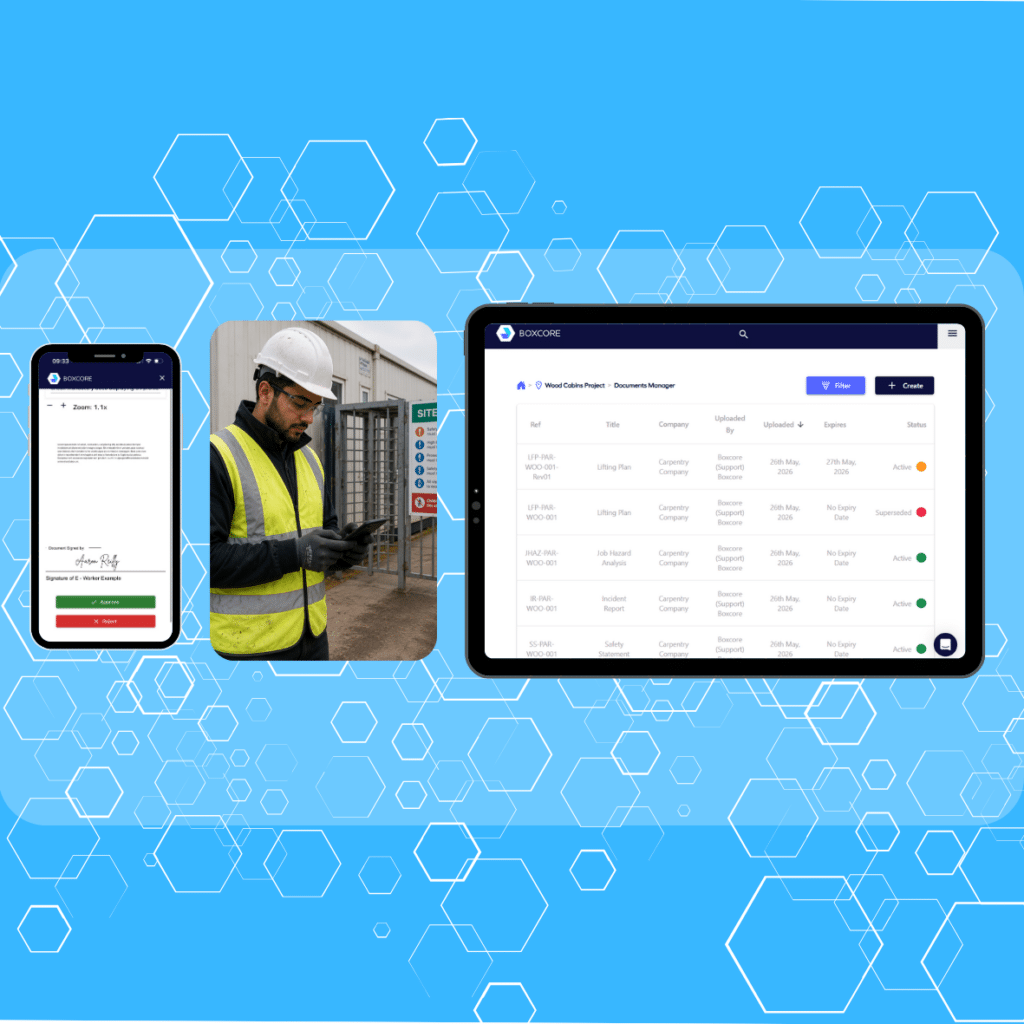
Managing training and competency on UK construction sites has never been more challenging. With CSCS card requirements, site-specific inductions, task-specific certifications, and constant changes in project scope, the days of relying on paper files or spreadsheet trackers are numbered. Digital training management software for construction is no longer a “nice-to-have” — it’s a core operational necessity.
Contractors who haven’t yet made the switch are facing real risks: missed expiry dates, inconsistent records across sites, and a lack of real-time visibility into worker competency. These issues can lead to costly delays, failed audits, and even site shutdowns. The good news? The right training management software can replace all those manual processes with an easy-to-use, centralised system that works for head office, site teams, and subcontractors alike.
This guide outlines five key things to consider when selecting training management software and four major benefits UK contractors gain by going digital — with practical insights from how Boxcore’s training management platform is already transforming sites across the country.
Historically, UK construction companies have tracked training using spreadsheets, filing cabinets, or email chains. While that might work for a single site with a small team, it quickly breaks down when projects scale, subcontractors rotate in and out, and requirements change mid-project.
Under UK regulations, principal contractors and subcontractors must prove that every operative on site is competent for the tasks they’re undertaking. This means keeping accurate, up-to-date records of:
When this information is scattered across multiple systems — or worse, left to individual site managers to track manually — errors are inevitable. This is why more and more contractors are moving to mobile-first training management software that gives instant visibility across all projects.
The most advanced software in the world won’t help if site teams find it clunky or time-consuming. As Padraig Reilly, CEO of Boxcore, explains:
“Software that isn’t immediately easy to use simply won’t get adopted — especially by site crews. Foremen, supervisors and subcontractors should be able to pick up the system and get going within minutes, without lengthy training sessions.”
Look for training management software designed specifically for construction environments, with a simple interface that works as well on a phone in the rain as it does on a desktop in the office.
With expiry dates constantly looming, you need a live view of who is qualified — and who’s not — at any given moment. Automated training registers, like those built into Boxcore’s workforce platform, remove the risk of missed renewals by flagging upcoming expiries and locking expired records from site access.
This is particularly useful for multi-site operations, where a single worker may be moving between projects.
One of the most effective ways to enforce training compliance is to link it directly to access control. With facial recognition or card-based turnstiles, only workers with valid training records can enter the site.
This not only ensures compliance but also prevents unsafe situations before they occur. Boxcore’s integrated time tracking and access control is a prime example of how this works in practice, eliminating manual checks at the gate.
In the UK, subcontractors make up a huge proportion of the workforce. Your training management software must allow subcontractors to upload and maintain their own workforce records — without compromising your oversight.
Boxcore’s approach is to give subcontractors a straightforward portal to add worker documents, while still giving the principal contractor real-time visibility and approval controls. This rapidly speeds up mobilisation and reduces back-and-forth emails.
Training data includes sensitive personal information, so it must be handled securely. Look for a provider with recognised security certifications – Boxcore is SOC 2 Type 2 certified – and the ability to produce instant audit-ready reports.
When the HSE or a client asks for proof of training compliance, you should be able to generate it in seconds, not spend hours piecing together evidence from multiple spreadsheets or hoping to find copies in manual folders.
Missed training renewals can shut down specific tasks or even entire work areas. With automated alerts and real-time registers, these risks are dramatically reduced. On high-value projects, this prevention alone can save thousands in lost time.
Manual data entry, chasing expired cards, and emailing documents all eat into productive time. Boxcore clients regularly report that their safety officers and site managers have cut training admin time by hours each week simply by having all data in one place.
This is especially valuable for Tier One contractors managing multiple subcontractors across large sites — but smaller firms benefit just as much.
With a single system controlling training compliance, you can apply the same rules and checks across every project. This not only keeps you compliant but also strengthens your reputation with clients, who see that your teams meet consistent safety and competency standards.
Linking this with digital onboarding for construction ensures that no worker starts on site without passing through your defined induction and training process.
More clients are demanding digital compliance reporting as part of prequalification. Being able to show instant, accurate training records — gives you a competitive edge when bidding for new contracts and free’s your site teams up to focus on project delivery rather than manual admin.
In a tight market, demonstrating that you run a professional, fully digital training management software can be a deciding factor in winning work. The right training management software accelerates this.
UK construction is under constant pressure to meet stricter safety standards while delivering projects faster and more efficiently. Manual systems simply can’t keep up with:
Contractors who delay moving to digital training management software risk falling behind competitors who can mobilise teams faster, pass audits more easily, and deliver consistent quality across sites.
As Boxcore’s experience across 1,100 projects shows, the switch doesn’t have to be painful. Most clients are fully operational within 24–48 hours, with existing training data migrated into the system and site teams trained in minutes.
Moving from spreadsheets to a centralised platform doesn’t just improve compliance — it transforms day-to-day operations. The key is selecting software built for construction, with a proven record of adoption among both main contractors and subcontractors.
To learn how Boxcore’s training management software can help you replace paperwork with real-time visibility, visit the Boxcore product features page or explore our guide to digital safety solutions for construction.
From worker onboarding, training records, compliance tracking, safety documents, equipment management, to on-site time and attendance tracking — Boxcore’s software greatly simplifies construction site safety.