

Safety software for utilities contractors has moved from a back-office nice-to-have to a frontline operational requirement. Utilities projects rarely look like traditional construction sites. Crews move daily, work in live environments, operate close to the public, and interact constantly with traffic, plant, and existing services. Managing safety across this landscape using spreadsheets, folders, and disconnected systems leaves too much room for error.
Utilities contractors face a combination of risks that are rarely present together on other projects: live electrical, gas, water, and telecoms services; constantly changing work locations; short-duration works; and a workforce that expands and contracts week by week. Add public roads, footpaths, and residential areas into the mix and the safety burden increases again.
This is where purpose-built safety software for utilities contractors becomes critical. Platforms like Boxcore are designed to give real-time visibility of people, training, equipment, and site conditions without adding admin or slowing crews down. Drawing on experience from live infrastructure projects across Ireland, the UK, Europe, and the US, Boxcore focuses on practical safety management that works in the field, not just in head office.
Why utilities contractors face a different level of safety risk
Utilities projects are defined by movement and change. Unlike a fixed commercial or residential site, a utilities contractor may work across dozens of locations in a single week. Crews are redeployed regularly, subcontractors rotate in and out, and hazards shift constantly.
Five challenges stand out across almost every utilities contractor operation.
1. Traffic management on live roads and public spaces
Traffic management is one of the most visible and high-risk activities utilities contractors undertake. Crews often work on live roads, junctions, footpaths, and near schools, hospitals, and housing estates. Poor traffic control exposes workers and members of the public to serious risk.
From a safety management perspective, traffic management brings several pressures:
- Workers must hold the correct, in-date traffic management training for their role and region
- Temporary traffic layouts change frequently as work progresses
- Inspections need to be carried out daily and sometimes multiple times per shift
- Evidence of compliance must be available instantly if an incident occurs
When this information is stored across paper files or spreadsheets, it is difficult to know if the right people are on site at the right time with the right training. Safety software for utilities contractors centralises traffic management training records, links them to individual workers, and allows supervisors to confirm compliance from a mobile device before work starts.
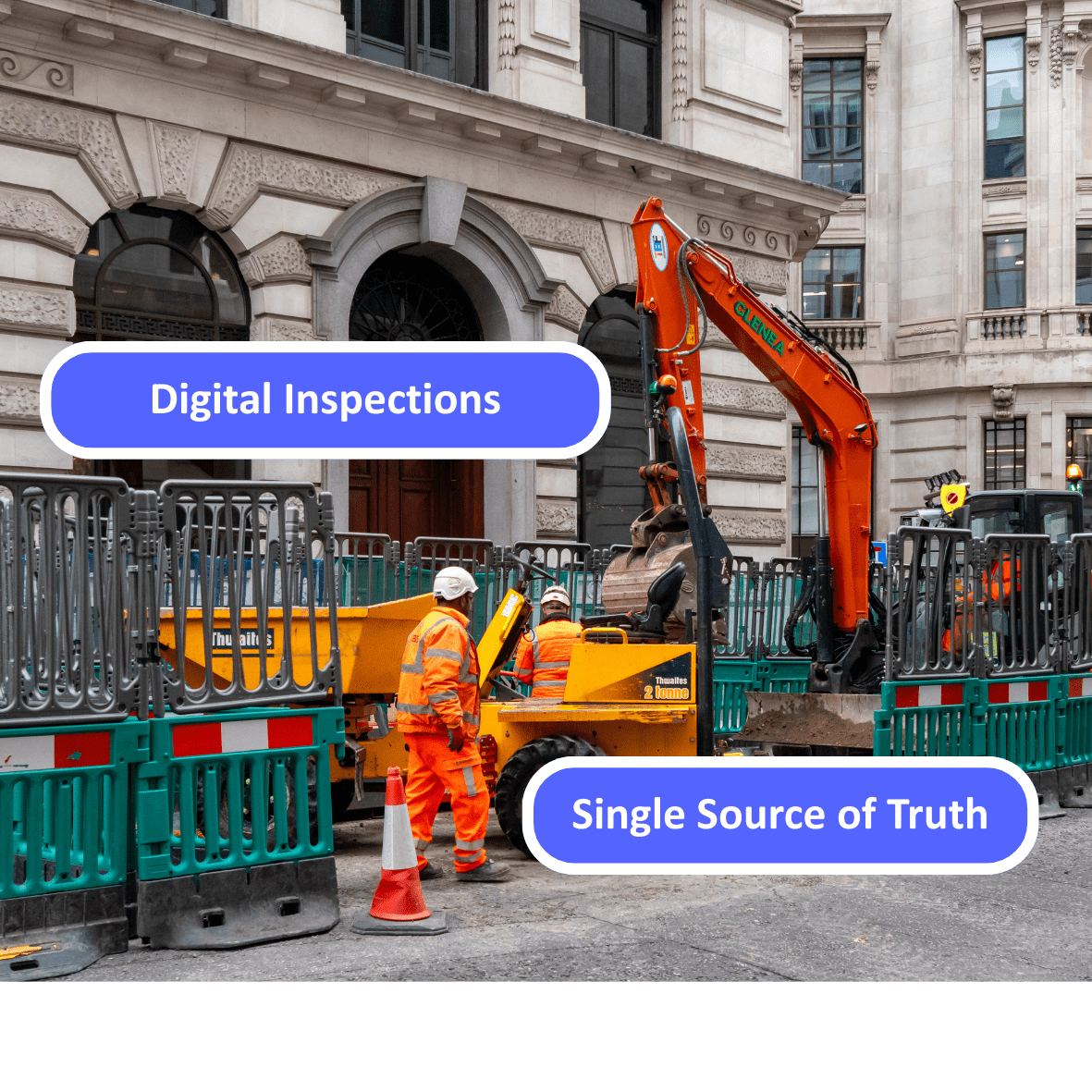
Digital site inspections allow traffic management checks to be completed in seconds, with photos, timestamps, and automatic records stored centrally. This reduces reliance on memory and paper, while providing a clear audit trail if questions are raised later.
2. Working close to live services
Utilities contractors regularly excavate and work beside live electrical cables, gas mains, fibre networks, and water infrastructure. The margin for error is extremely small. A missing permit, an outdated competency record, or an unclear handover can have severe consequences.
Key risks include:
- Crews arriving on site without project-specific or task-specific training
- Subcontractors unfamiliar with local service layouts
- Permits and method statements not accessible at the point of work
- Inconsistent briefings as crews change locations
Safety software helps manage this complexity by linking people, training, and documents to specific projects and tasks. Workers can only be approved for work when mandatory training, certifications, and project-specific requirements are in place. This applies across all regions, whether tracking Safe Pass cards in Ireland, CSCS cards in the UK, or OSHA cards on US projects.
By providing a single source of truth for training and documentation, utilities contractors reduce reliance on informal checks and verbal confirmation, which are common failure points when working near live services.
3. Interaction with members of the public
Few construction sectors interact with the public as directly as utilities. Work often takes place outside homes, shops, schools, and transport hubs. Members of the public may walk through or beside work areas, sometimes without understanding the risks involved.
Managing this interaction requires:
- Clear site setups and daily checks
- Consistent briefing of crews on public-facing risks
- Evidence that inspections and controls were in place
Paper-based systems struggle in these environments. Inspections completed on one street may never be uploaded centrally, and evidence can be lost or delayed.
Digital safety inspections allow supervisors to complete public safety checks on their phone, attach photos, and log actions instantly. This supports better standards on site and provides proof that controls were implemented, which is particularly important for client and local authority audits.
4. Interaction with plant and mobile equipment
Utilities projects rely heavily on mobile plant, often operating in tight spaces and alongside pedestrians and traffic. Excavators, breakers, compactors, and lifting equipment are frequently moved between sites.
This creates several safety management challenges:
- Equipment inspections may lapse as assets move between locations
- Operators change regularly, increasing the risk of misuse
- Records are hard to track across multiple short-term sites
Safety software simplifies plant and equipment management by maintaining live asset registers, inspection schedules, and operator competency records. Assets can be assigned to projects or individuals, inspections completed digitally, and alerts generated when checks are overdue.
This reduces the risk of equipment being used without valid inspections and gives utilities contractors confidence that plant compliance is maintained, even when projects are short-lived and spread across wide areas.
5. Confined space working
Confined space work is common across utilities, from chambers and pits to culverts and underground services. These activities require specific training, permits, rescue plans, and equipment checks.
Managing confined space safety manually is risky because:
- Permits are often site-specific and time-limited
- Training requirements vary by task and role
- Teams change frequently as work progresses
Safety software ensures only trained and approved workers are assigned to confined space tasks. Permits, rescue plans, and equipment checks can be stored digitally and accessed instantly on site. This is particularly important for audits and incident investigations, where demonstrating control measures is critical.
The added pressure of dynamic workforces and moving sites
Beyond individual hazards, utilities contractors face operational challenges that amplify safety risk.
Crews are dynamic. Subcontractors are added at short notice. Work locations move daily or weekly. Supervisors may be responsible for multiple sites spread over large geographic areas.
In these conditions, traditional safety admin breaks down. Training matrices become outdated within days. Paper records sit in vans or offices, disconnected from the reality on site. Supervisors spend too much time chasing paperwork and not enough time managing risk.
Safety software for utilities contractors is effective because it is designed to handle change. Training records update automatically. Worker onboarding happens quickly. Supervisors can see who is approved to work, where they are assigned, and what training they hold, all in one place.
How Boxcore supports utilities contractors in the field
Boxcore was built for contractors operating in complex, fast-moving environments. Utilities projects align closely with the conditions the platform was designed to handle. According to founder Padraig Reilly:
“At the end of the day, our goal is simple: we want to give contractors tools that actually make their lives easier on site. It’s about cutting down the admin, improving safety and helping teams get the job done with less hassle.”
Boxcore brings together the key elements utilities contractors need to control risk without slowing work down.
Simplified training and competency management
Utilities contractors must manage a wide range of training requirements, from general safety to highly specific task-based certifications. Boxcore maintains automated training registers that track expiry dates, project-specific requirements, and role-based competencies.
This allows contractors to:
- Verify training status before workers arrive on site
- Enforce project-specific and task-specific requirements
- Demonstrate compliance during audits and inspections
Training data is accessible to site teams, supervisors, and management from any device, reducing delays and uncertainty.
Relevant reading:
https://www.boxcore.com/boxcore-health-and-safety-software/
https://www.boxcore.com/iso-45001-compliance-for-construction-contractors
Fast worker onboarding for short-duration projects
Utilities projects often start with little notice. Crews may be mobilised quickly to respond to outages, repairs, or scheduled works.
Boxcore enables rapid worker onboarding by digitising inductions and document collection. Workers and subcontractors can be approved quickly once requirements are met, reducing downtime while maintaining control.
This is particularly useful when managing multiple subcontractors across different locations, where consistency is difficult to achieve using manual methods.
Further reading:
https://www.boxcore.com/effective-construction-worker-onboarding-how-boxcore-simplifies-the-process/
https://www.boxcore.com/subcontractors/
Plant and equipment management that keeps pace with moving sites
Utilities contractors cannot afford to lose track of inspections as equipment moves between sites. Boxcore’s asset management tools keep inspection records, documents, and assignments in one place.
Supervisors can check plant compliance in seconds, reducing the risk of uninspected equipment being used in live environments.
Related resource:
https://www.boxcore.com/product-features/
Digital site inspections and real-time visibility
Regular inspections are essential across traffic management setups, public interfaces, plant use, and confined spaces. Boxcore allows inspections to be completed digitally, with actions tracked and closed out centrally.
This improves consistency and reduces reliance on memory or paperwork, particularly when supervisors manage multiple sites.
Additional reading:
https://www.boxcore.com/digital-safety-solutions-for-construction/
A single source of truth across all utilities projects
Perhaps the biggest benefit of safety software for utilities contractors is visibility. Boxcore provides a single source of truth for safety data across all projects and locations.
Whether managing a small maintenance crew or a large regional programme of works, contractors can see:
- Who is approved to work
- What training and certifications are in place
- Which assets are compliant
- What inspections have been completed
This clarity reduces risk, improves decision-making, and cuts admin time significantly. These benefits are consistently highlighted across Boxcore deployments on live infrastructure projects Boxcore – Overview – 3rd of Mar….
Why utilities contractors are moving away from manual safety systems
Utilities work leaves little room for error. The combination of public exposure, live services, mobile plant, and confined spaces demands a higher level of control than spreadsheets and paper can provide.
Safety software for utilities contractors is no longer about ticking compliance boxes. It is about enabling supervisors and crews to manage risk in real time, across constantly changing conditions.
Boxcore focuses on simplicity, speed of adoption, and frontline usability. That approach has proven effective on projects where safety management must keep pace with the work itself.
For utilities contractors operating in dynamic environments, digital safety management is not an upgrade. It is a practical response to the realities of the job.
Utilities contractors need safety systems that keep pace with moving crews, short-duration works and high-risk environments. Boxcore is built for exactly these conditions. From managing training and worker onboarding to plant inspections and site audits, everything is handled in one easy-to-use platform that works on live sites.
If you’re still relying on spreadsheets, emails or paper folders to manage safety across multiple locations, now is the time to change. Boxcore helps utilities contractors reduce admin, improve visibility and stay compliant without slowing work down.
See how Boxcore works in practice and book a demo today.