
Construction competency management software has become essential for contractors who need clear visibility of worker training, project requirements and real-time site compliance. With tighter standards across the UK and Ireland, Europe and the USA, competency tracking can no longer rely on keeping information in folders, manual spreadsheets, email chains or last-minute chasing of subcontractors and site teams.
Contractors now need a system that helps them check worker training in seconds, enforce minimum requirements across projects and ensure site teams can quickly confirm whether workers have the right skills to carry out their tasks safely.
The underlying challenge is straightforward: competency management fails not because project managers or safety officers lack effort, but because the traditional tools used on most projects are too slow, too fragmented or too cumbersome for frontline workers to keep updated.
Boxcore was built specifically to solve this problem. Designed around simplicity and fast site adoption, it allows foremen, supervisors, subcontractors and project teams to access clear, accurate training and competency data in seconds. This focus on ease of use and intuitive design is highlighted throughout the Boxcore Solution Overview documents.
Before looking at the major benefits, this guide outlines the six essential capabilities every contractor should demand when selecting construction competency management software.
1. Ease of Use and Fast Site Adoption
If software is difficult to use, site teams will not adopt it—regardless of how impressive the sales demo looked. Construction crews work in high-pressure, fast-moving environments, often with long shifts, complex workflows and competing demands. They cannot afford to spend time navigating complicated systems.
Boxcore’s approach is rooted in real-world experience. Its founders, an experienced Civil Engineer and Project Manager, built the platform after seeing how legacy systems and manual methods consistently failed to gain adoption among frontline workers.
This is why Boxcore prioritises:
• clear, simple workflows
• strong mobile usability
• instant visibility of training status
• minimal onboarding time
• straightforward navigation
As shown on the product features page (https://www.boxcore.com/product-features/), training records, RAMS, attendance data and safety documents are all easy to update and view directly from a mobile device.
When software removes unnecessary complexity, adoption follows naturally. Supervisors stop relying on WhatsApp photos of certificates, subcontractors no longer submit outdated PDFs and project managers no longer rely on spreadsheets that fall out of date days after they are created.
2. Automated Training Matrices Produced On Demand
One of the most valuable tools on any project is an accurate, up-to-date training matrix. Unfortunately, on many sites, this matrix is maintained manually in Excel and becomes outdated almost immediately. Subcontractors submit inconsistent formats, training records arrive late and audits become far slower and more stressful than they should be.
Construction competency management software should automatically produce training matrices using real-time data.
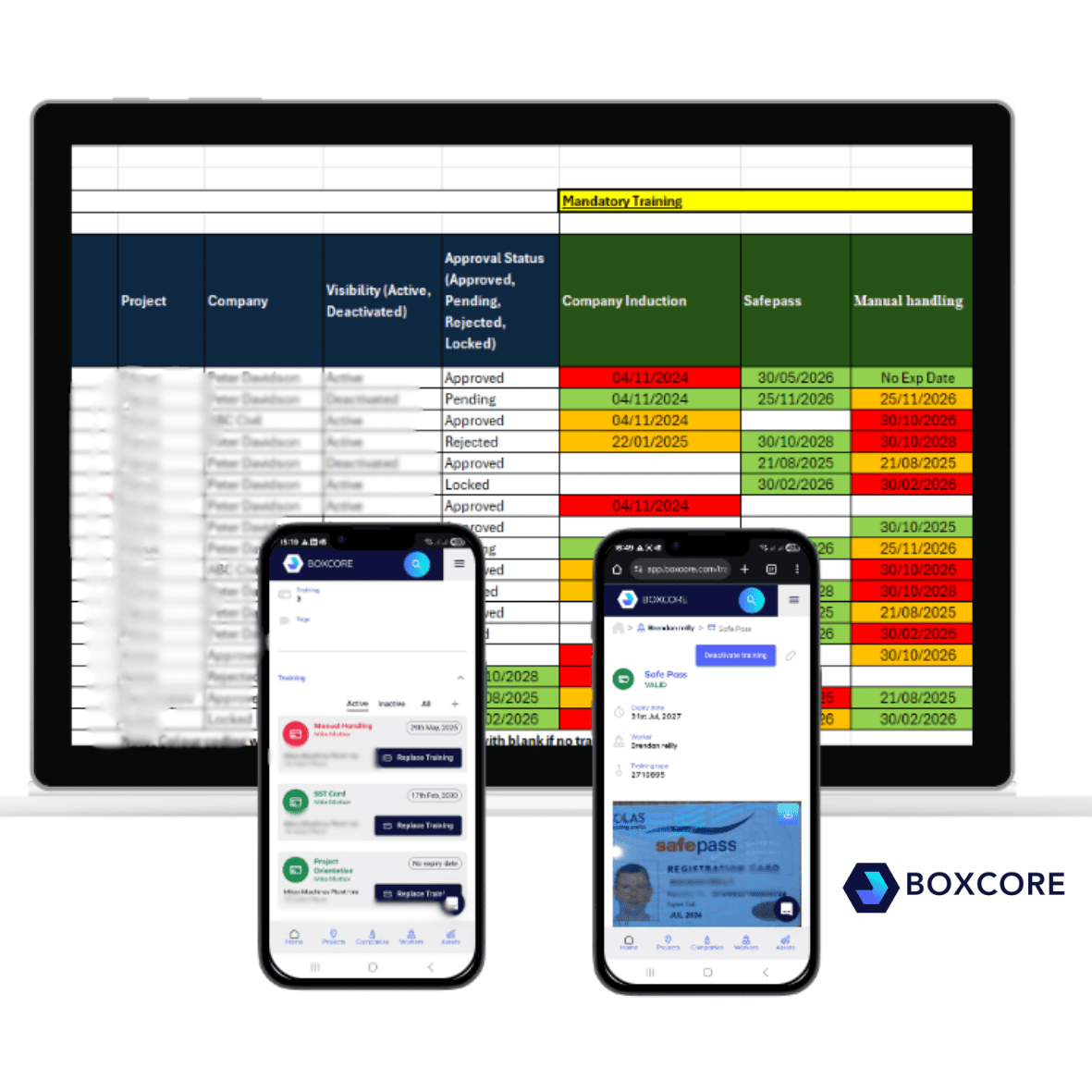
Boxcore does exactly this. As new workers join a project, complete digital inductions or update certifications, the training matrix updates instantly. Safety teams, project directors and supervisors can generate a matrix on demand with no manual editing required.
This automation, central to the Boxcore platform, is a major element of its solution overview documentation and significantly reduces the administrative workload associated with competency tracking.
For general contractors looking for a deeper understanding of how Boxcore manages training and workforce data, see:
https://www.boxcore.com/general-contractors/
3. Ability to Set Mandatory Training Requirements Across Projects
Modern construction projects have clear competency requirements. These vary by region:
• UK – CSCS cards plus site-specific requirements
• NYC – SST cards as required by DOB Local Law 196
• USA – OSHA cards plus orientation and task-specific training
Contractors also set internal competency standards that differ by project, task or client requirement.
Construction competency management software must allow teams to:
• set mandatory training requirements for each project
• apply task-specific or role-specific minimum standards
• prevent workers from accessing site if training is missing or expired
• give clear visual indicators of competency status
• notify subcontractors automatically when training expires
Boxcore enables all these controls. Supervisors can check competency in seconds. Subcontractors can see gaps before mobilising. Safety teams can ensure the correct certified personnel are available at the right time. And only approved workers can pass through connected facial recognition access points.
For more on subcontractor workflows:
https://www.boxcore.com/subcontractors/
4. Digital Inductions and Digital Orientations
Competency should’nt start when a worker arrives at the gate – it should start before they reach the site.
Digital inductions provide a structured, consistent onboarding process where workers complete project-specific briefings and upload required certifications before arrival. This ensures:
• no delays at the gate
• no missing training records
• no manual paperwork circulation
• supervisors know who is compliant before shift start
Across different regions, the terminology changes—induction in the UK and Ireland, orientation in the USA – but the principle is identical. Digital onboarding ensures the correct information is captured once, stored centrally and accessible instantly.
Boxcore’s digital inductions provide this workflow, increasing site readiness and reducing administrative overhead.
See: https://www.boxcore.com/effective-construction-worker-onboarding-how-boxcore-simplifies-the-process/
5. Digital RAMS and Toolbox Talks
Competency management extends beyond formal certifications. RAMS sign-off, toolbox talks and daily or weekly safety briefings form a critical part of ensuring workers understand the risks and procedures associated with their tasks.
Paper-based workflows cause ongoing problems:
• lost sign-in sheets
• inconsistent formats
• unclear audit history
• difficulty proving who received what information
• slow retrieval of old documents during inspections
Construction competency management software should allow safety teams to issue RAMS and toolbox talks digitally, track signatures automatically and store all evidence within the worker’s profile.
Boxcore centralises this process. RAMS, toolbox talks and safety documentation can be sent directly to workers’ devices, with time-stamped digital signatures collected instantly. This significantly improves record accuracy and simplifies audit preparation.
For additional guidance on digital safety documentation:
https://www.boxcore.com/simplifying-worker-safety-documentation-in-new-york-construction-with-boxcore/
6. Integration with Facial Recognition Access Control
Competency management must connect directly with access control—for safety, efficiency and accuracy. On projects where facial recognition devices are used, competency status should determine whether a worker can enter.
Boxcore integrates directly with facial recognition technology including the Suprema BioStation 3, enabling the system to:
• block access if required training is expired
• record accurate attendance data
• track subcontractor manpower
• provide real-time visibility of workforce levels
• link attendance data to competency status
This connection removes the risk of manual sign-ins, prevents untrained workers from entering site and provides reliable records for compliance and project management. This capability is outlined across Boxcore’s integrated access control documentation.
For more detail:
https://www.boxcore.com/boxcores-access-control-software-for-construction/
The Five Key Benefits of Construction Competency Management Software
Once contractors move to a digital competency platform, the benefits extend across compliance, safety culture, productivity and risk management. Below are the five most important advantages.
1. Better Compliance and Reduced Risk
With all training records, Safepass/CSCS/SST certifications, OSHA cards, RAMS sign-offs and toolbox talks in one place, compliance becomes far easier to manage.
Automated alerts, mandatory training rules and access control integration ensure no-one enters site without meeting requirements. Supervisors avoid the risk of relying on outdated records, and audits are completed faster.
This focus on automated registers and simplified compliance is a core feature of the Boxcore platform.
For further compliance support:
https://www.boxcore.com/iso-45001-compliance-for-construction-contractors
2. Faster Onboarding and Less Project Delay
Digital onboarding removes bottlenecks at the gate and reduces downtime associated with incomplete documentation. Subcontractors know in advance what is required. Workers arrive fully prepared. Supervisors avoid first-day delays.
Boxcore’s onboarding model prioritises simplicity and supports subcontractor training at no additional cost.
3. Real-Time Workforce Visibility
When competency data connects with facial recognition access control, project teams gain immediate insight into:
• who is on site
• who is authorised
• whether the right competencies are present
• which subcontractors are fully staffed
• whether training expiries will impact upcoming work
This visibility supports better planning and stronger safety oversight.
More on digital access visibility:
https://www.boxcore.com/access-control-software-for-construction/
4. Major Reduction in Admin Time
Competency management is one of the most time-consuming administrative burdens on any project. Spreadsheets, email chains and inconsistent subcontractor submissions create unnecessary work for safety officers and project managers.
With digital registers, automated training matrices, digital signatures and real-time updates, this workload reduces dramatically.
As Padraig Reilly puts it:
“At the end of the day, our goal is simple: we want to give contractors tools that actually make their lives easier on site. It’s about cutting down the admin, improving safety and helping teams get the job done with less hassle.”
5. Reduced Insurance Costs and Stronger Evidence During Claims
Insurers increasingly assess construction companies based on their ability to demonstrate effective competency management. Digital systems provide:
• timestamped training and certification records
• complete Safepass, CSCS, SST, OSHA and task-specific training logs
• digital RAMS and toolbox talk evidence
• attendance records linked to facial recognition access points
• proof that only trained workers were permitted onsite
This reduces uncertainty for insurers and strengthens a contractor’s position during policy reviews. In the event of a claim, digital records provide far stronger protection than paper files or fragmented spreadsheets, helping contractors demonstrate due diligence and avoid disputes.
If you’d like to see why over 200 Construction Companies of all sizes are using Boxcore to simplify site safety Book a Demo today.