
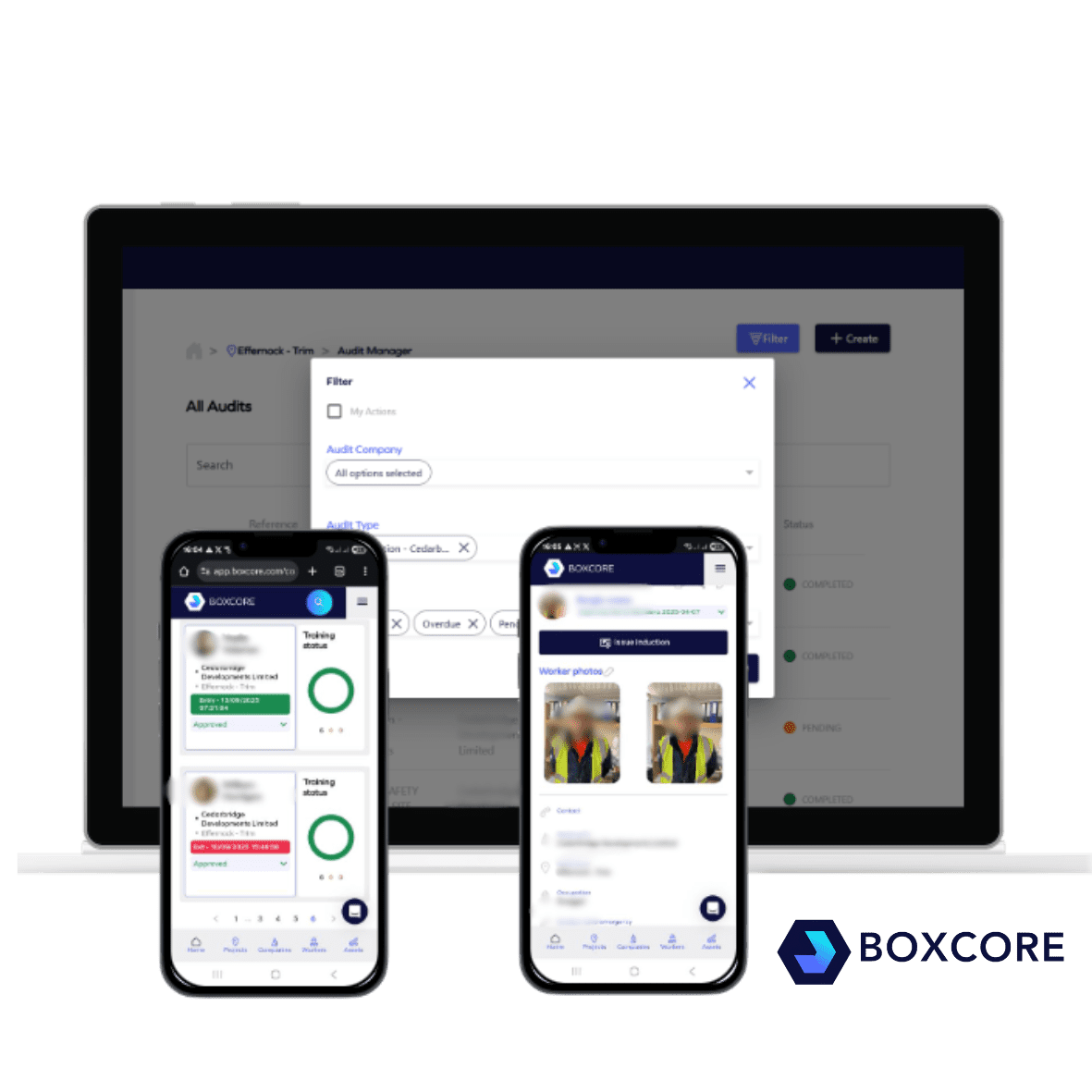

Training and competency management software has moved from a “nice to have” to a core system for UK construction companies. Increasing regulatory pressure, tighter client audits and growing reliance on subcontract labour mean contractors need absolute clarity on who is trained, competent and approved to be on site at any given time.
Yet many UK contractors are still relying on spreadsheets, shared drives and email chains to manage training records, CSCS cards, right to work checks and project specific requirements. These approaches create risk, waste time and fail when sites scale or audits arrive at short notice.
This article looks at what training and competency management software should actually deliver in a UK construction context. It breaks down six essential items to look for when evaluating systems and four clear business benefits that contractors gain when they move away from manual processes. The focus is practical, site focused and grounded in how UK projects really operate.
Why training and competency management matters on UK construction sites
UK construction sites operate under a complex mix of legislation, client requirements and industry standards. Beyond general health and safety law, contractors must manage:
CSCS card compliance for operatives and supervisors
Trade and role specific training such as plant tickets and specialist certifications
Project specific inductions and task specific training
Right to work documentation
Client and principal contractor minimum competency standards
Failure in any one of these areas can stop work, invalidate insurance or expose the business to enforcement action. The challenge is not understanding the rules. The challenge is managing the volume of data across multiple sites, subcontractors and constantly changing teams.
Training and competency management software exists to solve that problem, but only if it is built for real site conditions and real workflows and can be adopted quickly with busy construction teams.
Essential item 1: Simplicity and ease of use
The most important requirement is also the most overlooked. If the system is not simple, it will not be used properly.
On UK construction sites, training data is checked daily by site managers, safety officers and foremen. Subcontractors are asked to upload records. Head office teams need visibility without chasing updates. A system that requires lengthy training, complex navigation or desktop only access will fail quickly.
Effective training and competency management software should allow site teams to check a worker’s status in seconds from a phone or tablet and head office staff get instant visibility on the status of the teams training. It should be obvious whether someone is compliant or not without digging through files.
This focus on usability is critical for adoption, particularly among subcontractors who may be working across multiple contractors and platforms. Systems that are built with frontline users in mind consistently outperform more complex enterprise tools.
Essential item 2: Expiry alerts with a clear traffic light system
Training records are only useful if they are current. One of the biggest compliance risks on UK sites is expired training or cards going unnoticed until an audit or incident occurs.
A strong training and competency management system must provide automated alerts for expiring items, supported by a clear traffic light status:
Green for valid and in date
Amber for approaching expiry
Red for expired or missing
This needs to apply across all training, CSCS cards, right to work documents and project specific requirements. Alerts should be visible to site teams and head office and should trigger action before a worker arrives on site non compliant.
Manual reminder systems based on spreadsheets or calendar entries are unreliable at scale and prone to error. Automated alerts remove the dependency on individuals remembering dates and reduce the chance of something slipping through.
Essential item 3: Training matrices available on demand
UK contractors are frequently asked to produce training matrices for clients, principal contractors or auditors. These matrices show, by role or individual, exactly which training and competencies are held and whether they meet project requirements.
The problem with manual systems is that producing a matrix can take hours or days, often pulling data from multiple sources. This creates pressure, increases the risk of errors and reflects poorly during audits.
Training and competency management software should generate training matrices instantly. Filters should allow teams to view data by site, company, role or project. Exporting a matrix should be a one click task, not a manual exercise.
This capability is especially important for contractors working on regulated projects, framework agreements or design and build roles where audit readiness is expected at all times.
Essential item 4: Custom minimum requirements including right to work
No two projects are the same. One of the biggest weaknesses of generic systems is the inability to reflect project specific rules.
UK contractors need software that allows them to set custom minimum requirements at company or project level. These might include:
Mandatory CSCS card types
Specific trade certifications
Client defined training standards
Proof of right to work in the UK
Project specific inductions and briefings
The system should prevent a worker from being marked compliant unless all required items are in place. This removes ambiguity and protects site teams from making judgement calls under pressure.
Right to work checks are particularly important, as failure in this area carries serious legal and reputational consequences. Training and competency management software should treat these documents with the same rigour as safety training.
Essential item 5: Digital Inductions and Digital RAMS
Training does not stop at certificates. Ongoing site communication through Digital Inductions, toolbox talks, RAMS and task briefings forms a critical part of ongoing competency management.
Modern training and competency management software should allow these documents to be issued and signed digitally. This creates a clear record that workers have received and acknowledged information relevant to their tasks.
Digital signing removes paper handling, scanning and filing. It also makes records immediately available for inspection or investigation. For UK contractors managing multiple subcontractors, this capability saves significant time and reduces disputes around whether briefings were delivered.
Crucially, these records should sit alongside formal training data, giving a full picture of competence rather than fragmented records across different systems.
Essential item 6: Easy sharing of information with other parties
Construction is collaborative by nature. Training and competency data is rarely only for internal use. Clients, principal contractors, auditors and insurers all require access to information at different times.
Training and competency management software must allow secure, controlled sharing of data without exporting spreadsheets or emailing attachments. Access should be role based and auditable.
This ability to share information easily is particularly important for subcontractors working under multiple main contractors. Systems that simplify data sharing reduce friction and make subcontractors easier to work with, which has real commercial value.
Platforms such as Boxcore are designed with this collaboration in mind, allowing contractors to collect, manage and share safety and training data from one place .
The role of training software within wider safety and workforce management
Training and competency management should not sit in isolation. It works best when integrated with broader safety and workforce systems.
For example, linking training status with site access control and time and attendance ensures only compliant workers can access site. Integrating with onboarding processes ensures training is checked before work begins, not after someone arrives.
This joined up approach reduces gaps between systems and gives site teams confidence that the data they see reflects reality on the ground.
Four key benefits of training and competency management software
When implemented properly, training and competency management software delivers tangible business benefits beyond compliance.
Benefit 1: Removing compliance risk from projects
The primary benefit is risk reduction. Automated checks, expiry alerts and enforced minimum requirements significantly reduce the chance of non compliant workers being on site.
This protects contractors during audits, inspections and investigations. It also reduces exposure to enforcement action, project delays and reputational damage.
For UK contractors operating under increasing scrutiny, this level of control is no longer optional.
Benefit 2: Eliminating manual admin tasks
Manual training administration is time consuming and repetitive. Chasing documents, updating spreadsheets, checking expiry dates and responding to audit requests consumes valuable time that could be spent on productive work.
Training and competency management software automates much of this workload. Registers update automatically, alerts replace diary reminders and reports are generated on demand.
Boxcore customers consistently highlight the reduction in admin effort achieved by moving away from spreadsheets and email based processes .
Benefit 3: Improving site productivity and decision making
When site teams can see training status instantly, decisions are faster and more confident. Workers are not stood down unexpectedly. Access issues are resolved before they disrupt work.
This clarity improves productivity, particularly on larger or fast moving sites where labour levels change frequently. It also supports better planning, as managers can see at a glance who is available and compliant for upcoming tasks.
Benefit 4: Reducing insurance premiums and disputes
Insurers increasingly expect contractors to demonstrate strong control over training and competence. Digital records, clear audit trails and consistent enforcement of standards strengthen a contractor’s risk profile.
While reductions in premiums depend on individual circumstances, having robust training and competency management systems in place supports better insurance discussions and reduces disputes following incidents.
Clear records also protect contractors when responsibility is questioned, as evidence is immediately available.
Why UK contractors are moving away from spreadsheets
Spreadsheets struggle with scale, accuracy and accountability. They rely on time consuming manual updates, are prone to error and offer no real time assurance.
As projects become more complex and client expectations increase, spreadsheets simply cannot keep up. Training and competency management software provides a single source of truth that reflects what is happening on site, not what was last updated in an office.
This shift mirrors wider changes in UK construction, where digital systems are replacing paper based processes across safety, quality and workforce management.
What to look for when choosing a platform
When evaluating training and competency management software, UK contractors should look beyond feature lists and focus on outcomes.
Can site teams use it easily without extensive training?
Does it reduce admin rather than add to it?
Does it reflect how UK projects operate, including CSCS and right to work requirements?
Can it scale across multiple sites and subcontractors?
Solutions such as Boxcore have been developed specifically for construction, with a focus on frontline adoption and practical implementation across UK projects .
Final thoughts for UK construction companies
Training and competency management software is not about digitising paperwork for its own sake. It is about gaining control, reducing risk and freeing teams from unnecessary admin.
For UK contractors, the right system delivers clarity on site, confidence during audits and efficiency across the business. The wrong system creates friction, duplication and frustration.
By focusing on simplicity, automation and real site needs, contractors can turn training and competency management from a burden into a genuine operational advantage.
For those looking to modernise how they manage training, competence and compliance, now is the time to move away from spreadsheets and towards systems built for construction realities. to Find out why over 200 Contractors of all sizes are using Boxcore to simplify training and competency management Book a Demo today.