
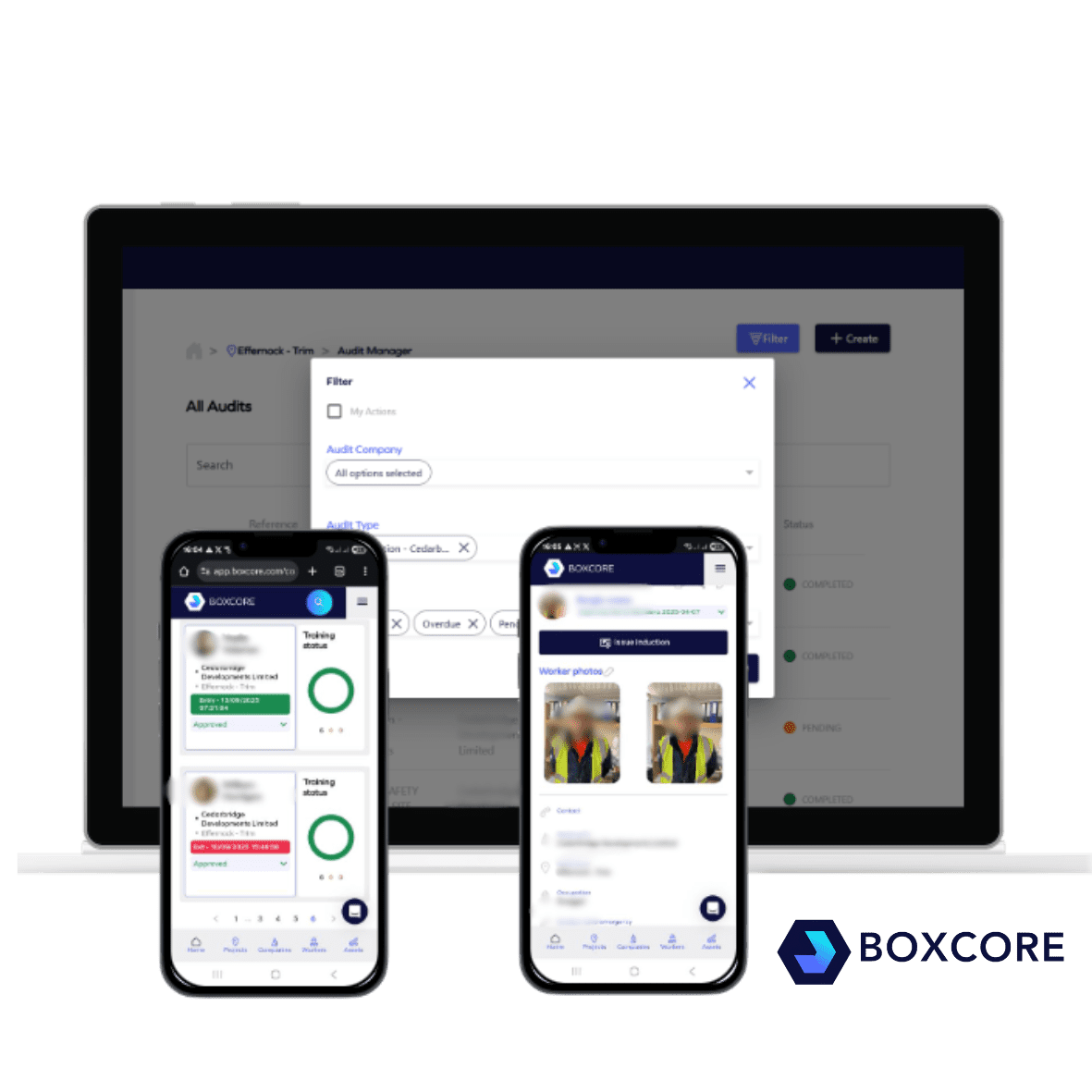

Access control software for construction has evolved significantly over the past few years. What was once viewed as a simple way to track who entered and exited a site has become a critical part of workforce management, compliance, safety and project delivery.
Across the UK construction industry, contractors are facing increasing pressure to demonstrate compliance, maintain accurate workforce records and improve site security. Principal contractors are expected to know exactly who is on site, whether workers hold the correct CSCS cards and qualifications, whether project-specific training has been completed and whether access permissions are up to date.
At the same time, site teams are already stretched. Site managers, supervisors and subcontractors are expected to manage growing amounts of documentation while maintaining programme, quality and safety targets.
This is where many traditional approaches begin to break down.
Paper sign-in books, spreadsheets, access cards and disconnected software systems often create more work than they remove. Information becomes fragmented across multiple platforms, compliance checks become manual and site teams spend valuable time chasing paperwork rather than delivering projects.
The most successful contractors are moving towards integrated access control software for construction that combines workforce management, compliance verification, attendance tracking and site access within a single platform.
When evaluating solutions, there are five key areas every UK contractor should consider.
Why Access Control Software for Construction Has Become Essential
Construction projects today generate vast amounts of workforce and compliance information.
A typical project may require contractors to manage:
- CSCS cards
- Right to Work documentation
- Digital inductions
- Training records
- Task-specific training
- RAMS acknowledgements
- Toolbox talks
- Attendance records
- Access logs
- Plant certifications
- Temporary works competencies
- Client-specific compliance requirements
Traditionally, much of this information has been managed through spreadsheets, email chains, paper folders and separate software systems.
The result is often duplication of effort, delayed reporting and poor visibility.
Many contractors only discover compliance issues when preparing for an audit, responding to a client request or investigating an incident.
Modern access control software for construction solves this problem by bringing workforce, compliance and attendance data together in one place. This creates a single source of truth while significantly reducing administration for project teams. Boxcore was specifically designed to eliminate data silos, automate manual processes and provide real-time visibility of workforce and safety information.
1. Access Control Software for Construction Must Be Easy to Use
The first and arguably most important consideration is usability.
Many software projects fail for one simple reason: site teams do not use them.
Construction environments are busy, fast-moving and often unpredictable. Supervisors do not have time for lengthy training sessions. Subcontractors do not want another complicated application. Foremen need answers quickly, not another administrative task.
When evaluating access control software for construction, contractors should ask:
- How long does implementation take?
- How much training is required?
- Can subcontractors use the platform immediately?
- Is it mobile-friendly?
- Can site teams access information in seconds?
A platform may have hundreds of features, but if site teams avoid using it, the investment quickly loses value.
The most effective systems are designed around frontline workflows rather than office processes. Workers should be able to complete onboarding quickly, supervisors should be able to verify compliance instantly and management should be able to access reports without extensive administration.
As Padraig Reilly, Founder of Boxcore, explains:
“Sometimes a piece of software might look wonderful on a demo, but you’re wasting your time unless you make sure it works on the ground and frontline staff can use the system successfully.”
The biggest measure of success is not how many features a system contains. It is whether it makes life easier for site teams.
For contractors looking to improve workforce and site management, the following pages may also be useful:
2. Choose a Platform That Combines Access Control, Compliance and Workforce Management
One of the most common challenges on construction projects is fragmented information.
It is not unusual to find:
- Attendance data in one system
- Training records in another
- Inductions stored elsewhere
- Access logs maintained separately
- Safety documentation held in shared folders
This creates unnecessary work for project teams.
Site managers often spend significant time gathering information from multiple locations simply to answer basic questions about workforce compliance.
Modern access control software for construction should eliminate this problem.
Rather than managing multiple applications, contractors should look for a platform that combines:
- Access control
- Time and attendance
- Workforce onboarding
- Digital inductions
- Training management
- Safety documentation
- Compliance tracking
Bringing these functions together creates a single source of truth while removing duplicate data entry. It also provides much better visibility across projects.
Boxcore was developed around this principle, bringing key workforce and safety processes together within a single platform while eliminating manual registers, emails and spreadsheets.
Learn more about Boxcore’s core capabilities:
3. Facial Recognition and CSCS Verification Should Work Together
Many traditional access control systems focus solely on attendance.
They record who entered the site but provide little information about whether that worker should have been granted access in the first place.
For UK contractors, this creates a significant compliance gap.
Before allowing access to site, contractors often need to verify:
- Valid CSCS cards
- Right to Work documentation
- Project-specific inductions
- Task-specific training
- Plant operator competencies
- Temporary works qualifications
- Client-specific requirements
Manually checking this information can become extremely time-consuming, particularly on large projects involving multiple subcontractors.
This is where facial recognition technology offers significant advantages.
The latest access control software for construction combines facial recognition with workforce compliance data.
When a worker arrives on site:
- Their identity is verified
- Their training records are checked
- Their CSCS card status can be reviewed
- Their project permissions are validated
- Their access eligibility is confirmed
This process dramatically reduces administration while helping contractors maintain compliance standards.
It also eliminates many of the weaknesses associated with traditional sign-in processes, including:
- Shared access cards
- Buddy punching
- Manual attendance records
- Delayed compliance checks
- Human error
Modern facial recognition systems have been specifically developed for demanding construction environments and provide reliable performance across varying site conditions. Boxcore’s facial recognition solution allows contractors to securely manage site access while providing real-time visibility of workforce attendance and compliance status.
4. Real-Time Visibility Is Critical
One of the biggest limitations of manual systems is the lack of real-time information.
Site teams often spend hours producing reports that are already out of date by the time they are reviewed.
Modern contractors need instant visibility.
At any point during the day, project teams should be able to answer questions such as:
- Who is currently on site?
- Which subcontractors are present?
- How many workers are on each project?
- Which workers have expired certifications?
- Are there any missing documents?
- Which inductions are outstanding?
- Are labour levels aligned with programme requirements?
Without real-time visibility, decision-making becomes reactive.
The best access control software for construction provides live workforce data through intuitive dashboards that can be accessed from any device.
This allows project teams to identify potential issues before they become problems.
Automated alerts can help identify:
- Expiring CSCS cards
- Missing documentation
- Training gaps
- Outstanding actions
- Compliance risks
Rather than spending time searching for information, site teams can focus on managing projects.
This real-time visibility is one of the key reasons contractors are increasingly replacing spreadsheets and manual processes with integrated workforce management platforms.
For more information on digital workforce and safety management:
5. The Software Must Adapt to Your Business
Every contractor operates differently.
A specialist subcontractor employing 50 workers has very different requirements from a Tier One contractor managing thousands of operatives across multiple projects.
The software should be flexible enough to support different project types, sectors and client requirements.
When evaluating access control software for construction, consider whether the solution can accommodate:
- Small and large projects
- Multiple subcontractors
- Different client compliance requirements
- Various access control configurations
- Future company growth
- Different reporting requirements
Flexibility is particularly important for UK contractors working across sectors such as infrastructure, rail, utilities, residential construction, commercial developments and data centres.
Each project may have different compliance requirements, onboarding processes and workforce structures.
The most effective solutions allow contractors to configure workflows while maintaining a consistent experience for site teams.
This reduces training requirements and makes scaling across multiple projects significantly easier.
The Most Important Question Every Contractor Should Ask
When reviewing access control software for construction, there is one final question that should sit above all others.
Will this make life easier for our site teams?
This is where many technology projects succeed or fail.
Software should remove administration, not create it.
It should eliminate paperwork, not digitise existing inefficiencies.
It should simplify compliance, not add additional processes.
Construction teams adopt technology when they quickly see practical benefits.
Those benefits typically include:
- Less paperwork
- Faster onboarding
- Easier compliance management
- Reduced administration
- Better visibility
- Fewer manual checks
If the software creates more work, adoption will inevitably suffer.
This focus on simplicity is one of the reasons contractors increasingly favour platforms built specifically for construction rather than generic workforce management tools. Boxcore’s entire approach is based on helping contractors eliminate manual administration while giving site teams access to key workforce and safety information within seconds.
Final Thoughts
Access control software for construction is no longer simply about controlling entry to site.
For modern UK contractors, it has become a critical part of workforce management, compliance, safety and operational efficiency.
The best solutions do far more than record attendance. They verify worker competency, validate CSCS cards, manage project-specific training, provide real-time workforce visibility and reduce administrative burden across the project team.
When selecting access control software for construction, focus on the factors that matter most:
- Ease of use and rapid adoption
- One platform for workforce and compliance management
- Facial recognition integrated with certification checking
- Real-time visibility across projects
- Flexibility to match your operational requirements
Most importantly, choose a solution that helps site teams do their jobs more efficiently.
Because in construction, the true measure of any technology is not the feature list. It is whether it saves time, reduces risk and helps projects run more smoothly every day.