
 Authored by:
Padraig Reilly
Authored by:
Padraig Reilly
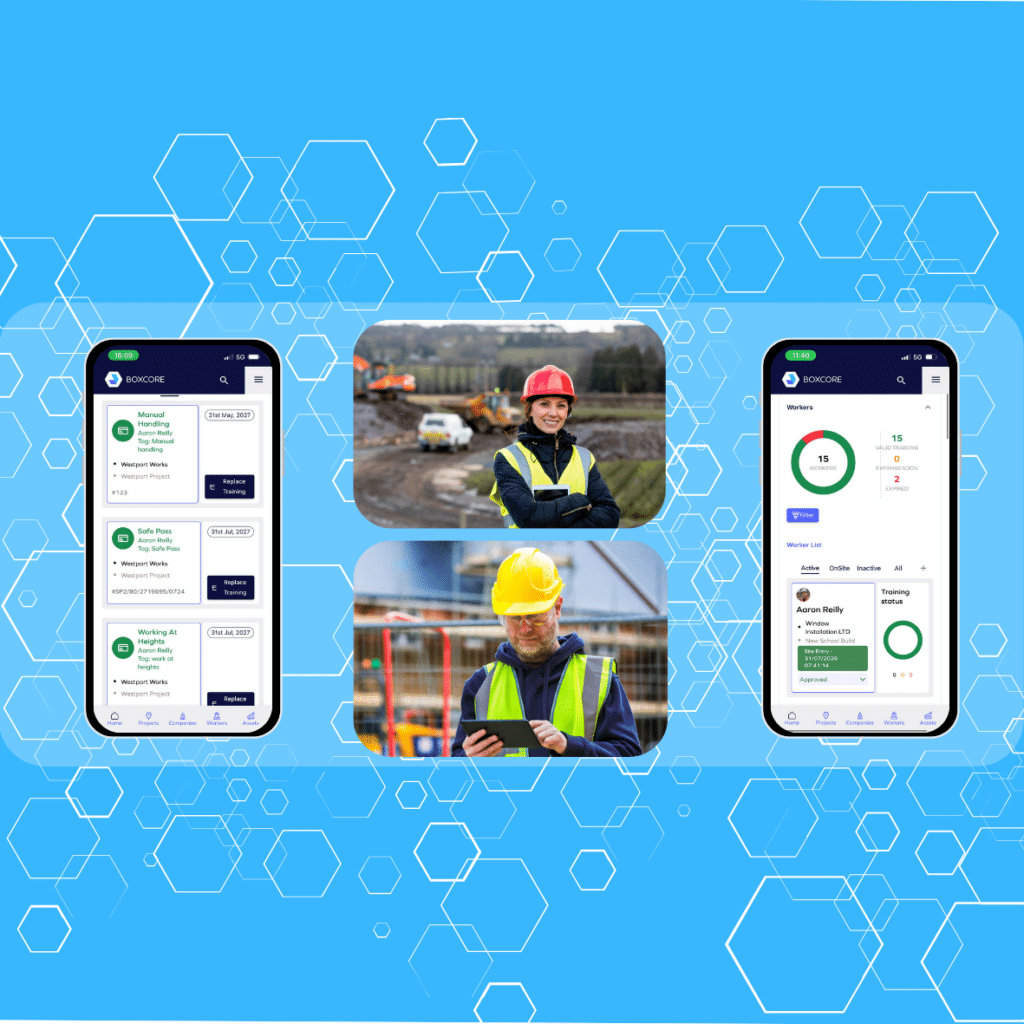
Tracking training and competency in construction is never as simple as ticking boxes on a spreadsheet. Sites are dynamic, project scopes change, and workers rotate between locations at speed. For contractors, ensuring that every operative has the correct training in place — and proof of it — is a daily necessity.
That’s where training register software for construction changes the game. Instead of scrambling through paper files or chasing subcontractors for certificates, you can see in seconds who is approved to work, whose credentials are due to expire, and whether all project-specific training has been completed.
But construction is unlike any other sector. You’re dealing with mobile workforces, varied compliance regimes, and frontline staff who don’t have time for complicated systems. Choosing the right platform isn’t just about ticking off features — it’s about ensuring it will actually be used on site.
This article outlines seven key things to consider when selecting training register software for construction, and four major benefits that make the investment worthwhile.
Manufacturing, logistics, and corporate sectors often use training systems designed for stable, office-based teams. Construction is different.
Projects are temporary. Crews are constantly changing. A single worker might be on a high-rise project this week and a civil works site the next. Add in multiple subcontractors, strict deadlines, and compliance rules that vary between regions — from CSCS cards in the UK, to Safe Pass cards in Ireland, to SST cards and OSHA training in New York — and the challenge of keeping accurate training registers multiplies.
Manual systems simply can’t keep pace. Excel sheets and paper files may work for a handful of workers, but at scale they lead to gaps, errors, and costly compliance failures.
That’s why contractors are now turning to platforms like Boxcore to manage training data digitally, link it with other safety workflows, and make it accessible to the people who actually need it — the site teams.
If your software isn’t straightforward, it won’t be adopted by site crews. In construction, there’s no luxury for lengthy rollouts or complex training sessions. The platform should be ready to use within days, not weeks, with minimal onboarding time.
Boxcore’s approach is a good example — contractors can be fully operational within 24–48 hours, with existing worker training data migrated at no additional cost. Subcontractors can be trained in minutes, ensuring the entire workforce is covered with minimal effort required by site teams to implement
At site level, information has to be clear. A colour-coded traffic-light system on training dashboards means managers can instantly see who is compliant (green), approaching expiry (amber), or out-of-date (red).
This visual clarity speeds up decision-making, avoids mistakes, and ensures workers without valid training are not allowed on site. The best training register software should include well-designed dashboards and should also work on mobile devices, allowing checks from anywhere on the project.
Manually updating registers is one of the most time-consuming admin tasks for safety teams. The right training register software should automatically update training records when a worker completes a course, when a document is approved, or when a certification is uploaded.
Automated registers in Boxcore remove the need for double or triple handling of data. Instead of searching through email chains, you have a single, up-to-date record of every worker’s training history.
Worker onboarding is a critical point in the safety process. If your platform supports digital inductions and orientations, you can get workers site-ready before they even arrive on site.
This is especially valuable for large or remote projects, where travel time can delay onboarding. In the US, this means ensuring OSHA and project-specific training are completed in advance; in the UK and Ireland, workers can upload proof of CSCS or Safe Pass cards as part of their induction.
Boxcore’s onboarding features let contractors deliver inductions, capture documents, and verify training remotely, reducing first-day delays.
RAMS, toolbox talks, and safety briefings often require signatures from multiple parties. A good training register system should integrate digital sign-off so that proof of attendance and understanding is instantly recorded against the worker’s profile.
This eliminates the need to scan and upload paper sheets, and ensures records are stored securely for future audits. It also links these sign-offs directly to the worker’s competency record, creating a full compliance picture in one place.
One of the most powerful developments in training register software is integration with site access control and facial recognition systems.
With this setup, only workers with approved training records can gain site entry. If a certification expires, access is automatically revoked until it’s updated.
Boxcore’s facial recognition system gives real-time visibility of who is on siteBOXCORE 12525 (003), linking directly to their training records. This is a major step in preventing unqualified workers from performing high-risk tasks.
Training register software shouldn’t be a standalone tool. They work best when combined with other safety and workforce management features — such as equipment inspections, document management, and time tracking.
By bringing everything into one platform, you eliminate data silos, reduce the number of systems workers have to learn, and ensure information is consistent across all safety workflows.
Boxcore’s platform is designed this way — training records, safety documents, access control, and time tracking all live in the same environment.
By ensuring only trained, competent workers are on site, you lower the likelihood of accidents, non-compliance fines, and project delays. The system acts as a constant, automated check on your workforce’s readiness.
When linked to access control, this risk reduction is even more significant — no manual checking, no lapses.
Digital registers remove hours of manual data entry, scanning, and email chasing. Admin staff can focus on higher-value tasks, and site managers can spend more time supervising work rather than validating paperwork.
In one real-world example, a contractor using Boxcore cut their training admin workload by over 90% in the first month
Insurers increasingly recognise that robust digital safety systems reduce claims risk. Maintaining airtight training records — and being able to demonstrate them instantly — can help negotiate lower premiums or meet policy requirements.
For contractors with multiple sites, this consolidated approach can translate into significant annual savings.
When workers arrive on site already inducted and fully compliant, there’s no downtime waiting for paperwork to clear. Access is granted instantly, and supervisors can allocate tasks without delay.
With real-time dashboards showing the competency status of every team member, the right training register software empowers managers to deploy the right people to the right tasks without hesitation.
Not all training register systems are built for the realities of construction. A generic LMS may track courses, but it won’t integrate with access control, link to RAMS sign-offs, or update registers automatically when documents are approved.
By choosing a platform built for site conditions — one that works on mobile, handles low-bandwidth environments, and is intuitive for all technical abilities — you get the adoption you need and the compliance confidence your projects demand.
For contractors, training register software for construction is no longer a “nice to have” — it’s a compliance, safety, and productivity essential.
When evaluating options, focus on systems that combine speed of adoption, clear dashboards, automated updates, online inductions, digital sign-offs, access control integration, and the ability to manage all safety workflows in one place.
The result is fewer risks, less admin, lower costs, and smoother site operations — benefits that will be felt from head office to the front gate.
To see how Boxcore can deliver these results for your projects, explore our access control solutions or book a demonstration today.
From worker onboarding, training records, compliance tracking, safety documents, equipment management, to on-site time and attendance tracking — Boxcore’s software greatly simplifies construction site safety.
Site compliance in construction has never been more complex or more important. With evolving regulations, multi-tier subcontractor chains, and constant workforce turnover, staying compliant isn’t just a legal requirement — it’s a daily operational challenge. That’s where construction safety software is making a measurable difference.
Construction safety software helps contractors simplify compliance by digitising records, automating document control, and improving visibility across every aspect of site safety. The shift from paperwork and fragmented spreadsheets to integrated digital systems is driving better safety outcomes, fewer delays, and greater accountability across the supply chain.
Construction projects involve multiple moving parts. Training records, RAMS documents, asset inspections, CSCS or Safepass cards, inductions, time tracking — it all has to be collected, validated, and kept up to date. The risk of something slipping through the cracks is high, especially when:
For most contractors, compliance is still a manual process. It’s labour-intensive, hard to audit, and prone to human error. And when something is missing — whether it’s an expired training cert or a forgotten inspection — the consequences can be serious: lost time, site closures, insurance issues, or worse.
Construction safety software like Boxcore is purpose-built to replace this manual chaos with structured, easy-to-use tools that make compliance automatic rather than reactive.
At a high level, the software brings together several essential safety functions into one platform:
All of this is available via mobile and desktop, designed for use on the ground by foremen, site managers, engineers, and safety officers alike.
“At the end of the day, our goal is simple: we want to give contractors tools that actually make their lives easier on site. It’s about cutting down the admin, improving safety and helping teams get the job done with less hassle.”
— Padraig Reilly, CEO & Founder of Boxcore
The first place where construction safety software delivers results is at the point of entry — the onboarding stage. Boxcore allows teams to set up digital onboarding flows that walk workers and subcontractors through what’s required before stepping foot on site:
Because this data is captured once and stored centrally, there’s no need for repeated collection on every new job. Workers can be approved quickly, and site managers can instantly see who is compliant and ready to work.
For general contractors, this saves hours every week. For subcontractors, it removes the frustration of re-uploading the same documentation for each new contract.
Explore how Boxcore simplifies worker onboarding
Once workers are on site, the next compliance challenge is keeping data current. This includes:
In a manual system, this involves spreadsheets, email reminders, or folders in a site office — and often results in last-minute scrambles before audits or inspections.
With Boxcore, all registers are automatically updated in real time. Each document or training record is linked to the relevant worker, role, or asset. Notifications alert the team before anything expires. Everything can be viewed from any device in seconds.
For larger projects or firms operating across multiple sites, this centralised visibility is essential. Head office can oversee site compliance without relying on emailed updates or phone calls from supervisors.
See how Boxcore improves document management
Audit preparation is one of the most time-consuming parts of any safety manager’s job. Whether it’s an internal review, ISO 45001 compliance check, or a regulatory inspection, gathering and verifying documentation can take days or even weeks.
With construction safety software, audit preparation becomes a matter of clicks, not chaos. Key benefits include:
For companies working under frameworks with strict compliance demands — including ISO, Local Law 196 in NYC, or the UK’s Building Safety Act — this kind of system-level traceability is a must.
Read more: Staying compliant with Local Law 196 in NYC
Another area where safety software is transforming compliance is in access control. On sites with turnstiles or restricted entry points, facial recognition tools can ensure that only compliant, approved workers can gain access.
With Boxcore:
This eliminates the risk of unauthorised or untrained workers gaining site access. It also gives safety officers a live view of who is on site at any moment — which is critical for emergency roll calls and general risk oversight.
Find out more about Boxcore’s access control software
Another pain point in compliance is tracking who has what training — not just once, but across projects and over time. Boxcore solves this by keeping a persistent profile for each worker, containing:
Whether a worker moves from one job to the next or switches roles, their training record stays with them. This reduces duplication and helps employers make better, faster staffing decisions.
It also allows site managers to instantly validate whether a team member is cleared for specific tasks, lifting operations, or access to restricted areas.
Boxcore has now been used on over 1,100 construction projects, with more than 40,000 worker profiles created. Feedback from contractors consistently points to two big wins:
For teams managing multiple subcontractors, or working under the pressure of tight delivery timelines, these wins translate into real operational value.
Check out: 5 ways contractor safety software delivers real improvements
Construction safety software isn’t just a tool — it’s a foundation for building a proactive safety culture. When teams can clearly see what’s required, know where to find the data, and trust that records are accurate, compliance becomes second nature rather than a headache.
For safety managers, it reduces stress and paperwork. For directors, it provides peace of mind and audit protection. And for frontline site crews, it removes friction and helps get the job done safely.
If your safety system still relies on folders, forms and guesswork, it might be time to explore what a modern solution can do for your projects.
Learn more about how Boxcore helps general contractors and subcontractors stay on top of safety compliance — without the admin overload.